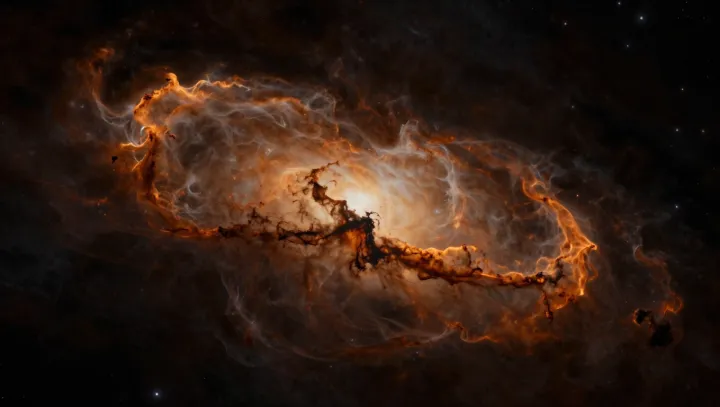
Darkness is not empty; it is loaded. In the deepest interstellar shadows, giant molecular clouds sit at temperatures only a few degrees above absolute zero, hiding huge reservoirs of molecular hydrogen and dust. Within them, turbulence and magnetic fields carve dense filaments, thin as threads on a galactic scale yet far heavier than any star they will produce.
Paradox defines these regions. Because they are cold, gas particles move slowly, so thermal pressure cannot resist gravity once a filament exceeds its Jeans mass, the critical threshold for collapse. Gravity then amplifies tiny density fluctuations, driving material inward, compressing the invisible gas until its central core becomes optically thick and forms what astronomers call a protostar.
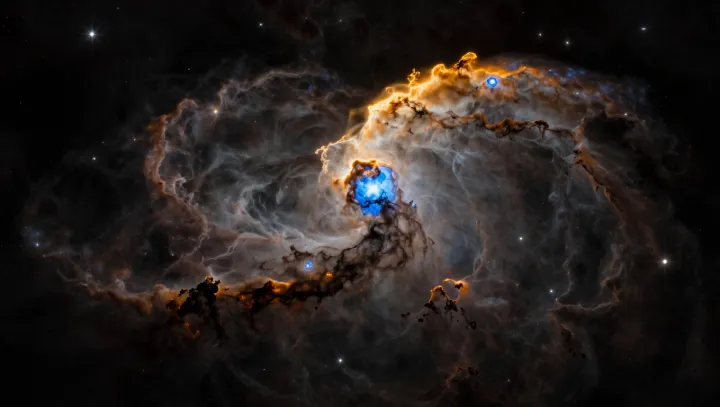
Violence follows silence. As the protostar contracts, gravitational potential energy turns into heat, raising central temperature and pressure until nuclear fusion ignites, converting hydrogen into helium and releasing intense radiation. That radiation, along with stellar winds and ionizing photons, blasts cavities in the original cloud, lighting up the surrounding nebula. The same dark cold that once hid the gas becomes the background against which the newborn star blazes.