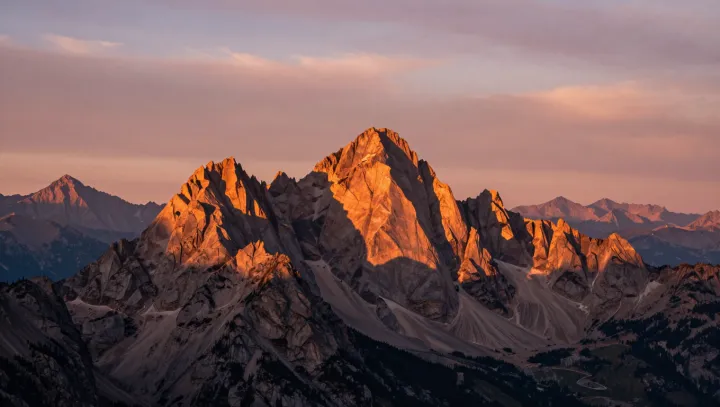
Bare rock does not change; the sky edits it. At low sun, Earth’s atmosphere stops acting like a neutral window and starts behaving like a selective filter, stretching the path that sunlight must cross and forcing shorter wavelengths to lose the fight.
This glow is not magic; it is Rayleigh scattering weaponized by geometry. When the sun skims the horizon, photons traverse a much longer optical path length through air molecules and aerosols, so blue and violet light are scattered out of the direct beam, while red and orange wavelengths, less vulnerable because of their longer frequency, remain in the transmitted spectrum that actually reaches the cliff face.
The rock’s mineral lattice stays the same, but its reflected spectrum is hijacked. Illuminated now by a beam already stripped of most short wavelengths, its usual mix of reflected light is reweighted toward the long end, so even basalt or granite, under this skewed incident spectrum, returns a signal dominated by red and orange photons to an observer’s retina.
Call it a quiet conspiracy between radiative transfer and human vision. The atmosphere rebalances the incoming solar spectrum, surface reflectance passively obeys, and the eye, more sensitive to red in dimmer conditions, completes the illusion that stone has suddenly learned to burn.