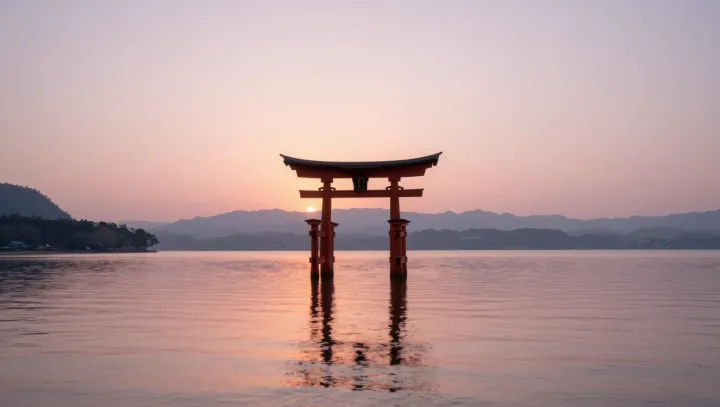
Saltwater should win. Those vermilion gates stand anyway, their legs braced in surf that chews through steel and spalls concrete. At work is not magic but structural cunning: massive columns pass through fitted stone sockets, the footing buried under sediment so the load spreads into compacted seabed rather than a single rigid slab.
The real surprise is how much these structures trust wood friction. Mortise‑and‑tenon joints and transverse nuki tie‑beams are cut so tight that swelling fibers create compression fit, a kind of organic pre‑stress that locks members together without bolts. Instead of resisting hydrodynamic loading with brute stiffness, the frame yields slightly, dissipating energy as micro‑slip at the joints rather than as cracks.
Durability here is less about thickness and more about controlled decay. Columns are over‑sized so the sacrificial outer layer can erode while the core keeps carrying axial load. Periodic replacement of selected members treats the torii as a maintained system, not a frozen monument. Out in the shallows, what looks like stillness is actually a slow, engineered negotiation with water and salt.