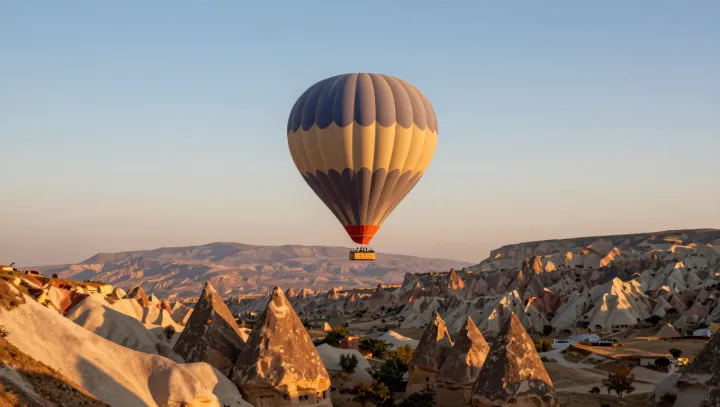
That balloon is not magic at all; it is ruthless physics in slow motion. Against the pale desert sky, its envelope swells, the fabric barely shivering as burners nudge the air inside just above the cool morning outside. No roaring furnace. No glowing core. Only a modest rise in temperature that quietly rewrites the balance of forces between sky and stone.
The blunt truth is that gravity loses this skirmish because density matters more than drama. Warmed by a few brisk blasts, the air inside the balloon expands, and under the ideal gas law its density drops below that of the surrounding air. Archimedes’ principle then steps in with bureaucratic precision: the heavier outside air pushes up on the lighter balloon system, generating buoyant force that can exceed the total weight of fabric, basket, fuel and clustered passengers. A small temperature gap, but spread across a vast envelope, multiplies into thousands of newtons of lift.
More counterintuitive still is how little warmth the desert dawn demands. Cool ambient air starts dense, which hands the pilot an advantage; every slight internal increase in temperature produces a sharper density contrast, and thus more lift, than it would on a sweltering afternoon. Between jagged formations, turbulence stays low and the aerostat behaves almost like a stately elevator, controlled by micro-adjustments in burner output and the resulting vertical velocity. Below, rock spires look hostile and immovable. Above, the basket hangs from a bubble of slightly rearranged molecules, proving that height is often won not by firestorms, but by marginal gains in invisible air.