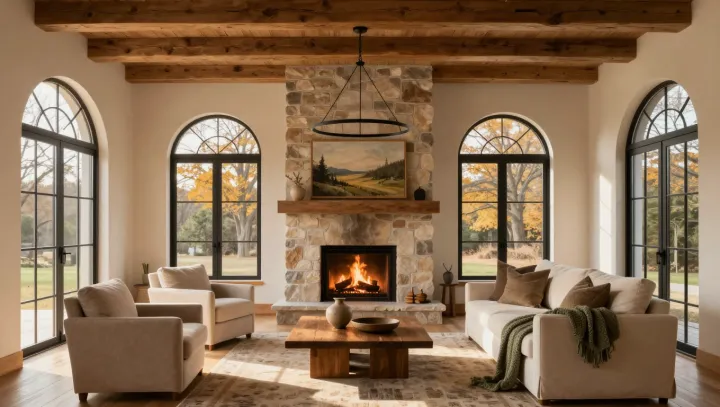
Bare surfaces, designers insist, do more for your pulse than another throw pillow ever will. When visual stimuli drop, studies on cognitive load and attentional control show the brain stops running constant threat detection and begins shifting into parasympathetic dominance, the slower gear linked with rest and recovery.
At the center of this quieter equation sit natural materials. Wood, stone and linen scatter light with a softness researchers call low specular reflectance, and that reduces harsh contrast edges the visual cortex must keep tracking. Their micro texture also feeds the somatosensory system in a predictable way, which explains why a single wooden armrest can feel more reassuring than a shelf of small ornaments.
Lighting comes next, and here the verdict is blunt. Overhead glare keeps the body in task mode because it mimics midday spectral power distribution, while warm low-level lamps signal the circadian system to wind down. Designers now talk about correlated color temperature and luminance gradients the way audiophiles talk about signal noise: the goal is less stimulus, more signal.
Most radical, though, is the idea that empty space itself is a design tool, not a missing purchase. Negative space cuts the number of visual objects the brain must encode in working memory, easing decision fatigue and even lowering measured heart rate in lab mockups. Silence between notes makes music; the same logic holds for the gap between a sofa, a soft lamp and a single wooden table.