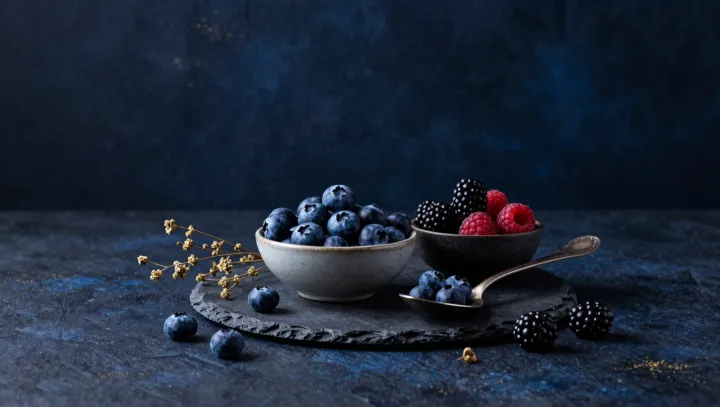
Those berries on your plate are not passive garnish. Blueberries and blackberries run a quiet structural game, holding firm in a fridge yet collapsing on cue when a pan warms. Chilled, their parenchyma cells sit under low internal pressure, with pectin networks and cellulose walls acting like a mesh that locks in shape and traps water, so cheesecake toppings and parfait layers stay clean, defined, almost architectural.
Heat changes the contract. Brief exposure softens cellulose, loosens hemicellulose, and starts solubilizing protopectin into pectin, while anthocyanin pigments leak through microfractures in the skins. Sugar in the surrounding syrup increases viscosity through simple colligative effects, so the released juice thickens instead of running thin. One minute in a hot pan and you get intact skins floating in a self-made gel, a glossy, spoonable sauce that clings to ice cream rather than flooding the bowl.
That toggle is the smart move for modern dessert design. Keep berries cold to leverage their native structure as stackable units, or apply a short heat hit to trigger controlled cell rupture and pectin gelation. A single ingredient, two textures, decided not by recipe category but by whether you respect the chill or flash the flame.