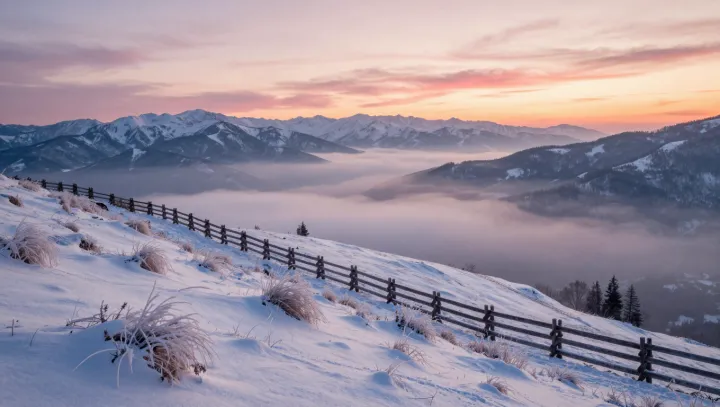
That winter ridge is lying to your eyes. Along the frozen horizon, low solar altitude forces sunlight to cross a longer atmospheric path, so Rayleigh scattering strips out much of the short blue wavelengths and leaves a spectrum skewed toward red and orange, even while the physical color temperature of the sun remains high.
The scene looks warmer still because the foreground is ice. Snow has high albedo in the visible range yet reflects slightly more efficiently in the red part of the spectrum at shallow angles, so those already filtered rays bounce off the slopes and back to the eye, exaggerating every amber and rose tone against a field of neutral white.
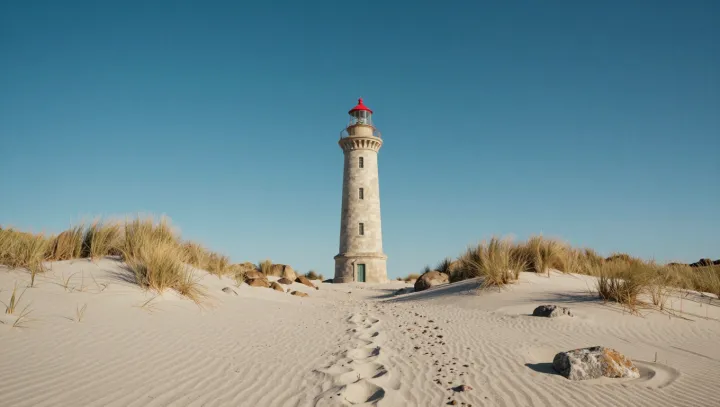
Summer noon, by contrast, is visually honest to a fault. Overhead light travels through less air, suffers less Rayleigh scattering, and reaches the ground with a spectrum closer to balanced daylight, which our visual system, through chromatic adaptation, normalizes toward white, flattening any hint of warmth despite the higher surface temperature.