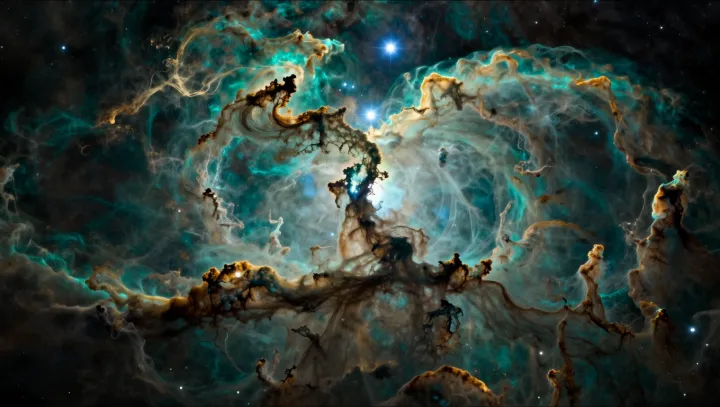
Those towering gas pillars are not monuments. They are collateral damage from young massive stars blasting their birth cloud with radiation and wind, a process astronomers call stellar feedback. At the same time, the same engines that chisel those sharp edges are quietly sabotaging any fresh generation of stars hiding inside the gas.
The harsh trick lies in ionizing photons and ram pressure. Intense ultraviolet radiation strips electrons from hydrogen, turning cold molecular gas into hot plasma that expands and leaks away as photoevaporative flow, while hypersonic stellar winds sweep the region clean. Dense knots at pillar tips can briefly collapse under self‑gravity into protostars, yet the surrounding envelope is eroded faster than new cores can assemble, so the global star‑formation efficiency drops rather than rises.
What looks like a nursery is, on larger scales, a shutdown protocol. Shock fronts, H II region expansion and radiation pressure carve theatrical silhouettes for telescopes, but they also punch holes in the cloud, vent gas into the wider interstellar medium and halt further gravitational collapse, leaving a few survivors and a dispersed, sterilized sky.