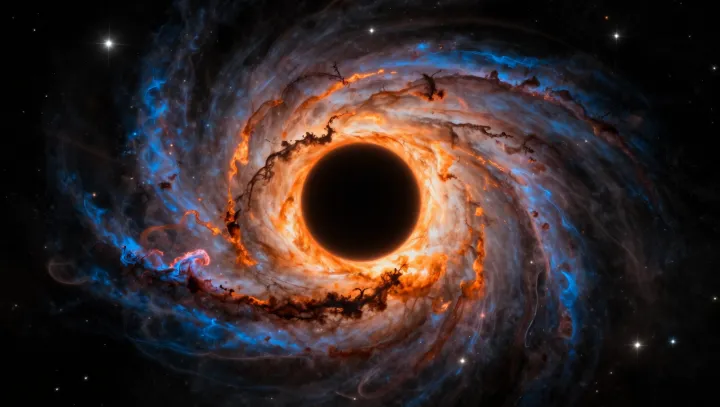
A black hole’s disk looks like it should fly apart, yet it behaves more like a regulated engine than a bomb. At the core of that restraint is gravity, which does not just pull inward; it sets the orbital speed that keeps gas circling instead of escaping. Gas in the accretion disk moves in nearly Keplerian orbits, its motion dictated by the black hole’s mass and by the curved spacetime described by general relativity.
The real surprise is how inefficient the violence is. As magnetic turbulence and viscous shear heat the plasma, only a fraction of the gravitational potential energy turns into escaping photons; the rest stays as orbital motion. Radiation pressure does push outward, but not fast enough to unbind material whose escape velocity is a significant fraction of light speed. Instead of a shockwave, the disk experiences a slow outward leak of energy through radiative cooling, while angular momentum transport lets matter spiral inward across the innermost stable circular orbit.
So the disk survives because its own fury is throttled. Gravity locks the gas into orbits, relativity fixes the last safe track before plunge, and the rate of energy loss remains finite rather than runaway. What looks like chaos is an accretion flow caught in a narrow corridor between collapse and blowout, bright precisely because it never quite manages either.