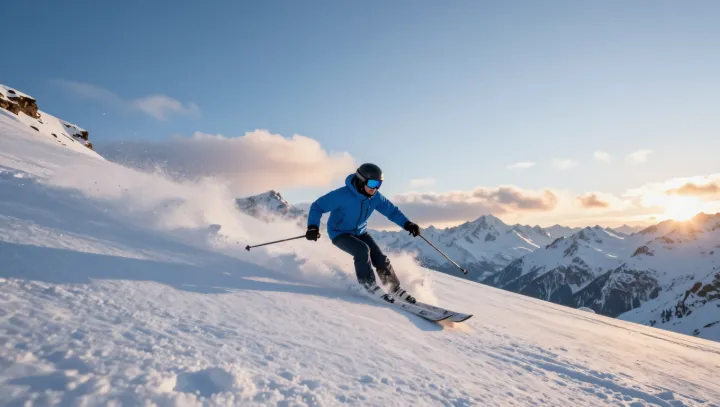
Chaos, not comfort, is where elite skiing is built. Soft, chopped, unpredictable powder throws constant disturbances at the body, and those disturbances are exactly what refine balance reactions, edge control, and pole timing under real stress, not training-hall calm.
The blunt truth is that perfect groomers lie. They hide asymmetries, they forgive late pressure on the ski, they let a racer get away with sloppy center of mass control. In powder, every micro error shows up as tip dive, tail washout, or a missed pole plant, which gives the nervous system dense, high-quality feedback. Motor learning research calls this high contextual interference: varied, unstable inputs that force the brain to refine movement patterns more deeply than repetitive, identical turns ever can.
Safety, counterintuitively, grows in this mess. By constantly recalibrating proprioception and vestibular responses in chopped snow, skiers expand what biomechanics labs describe as their stability envelope, the range of joint angles and ground forces they can manage without crashing. Edges must bite at changing depths, so athletes refine pressure distribution along the ski and increase usable friction without overloading the knee. Pole timing becomes a metronome and a probe at once, giving early terrain information while anchoring upper–lower body separation. The result is a skier whose technique has been stress-tested in noise, so race-speed on groomed ice becomes, relatively speaking, the easy part.
Powder, in that sense, works less like a playground and more like a pressure chamber for skill acquisition, where speed and safety stop being trade-offs and start becoming the same outcome.