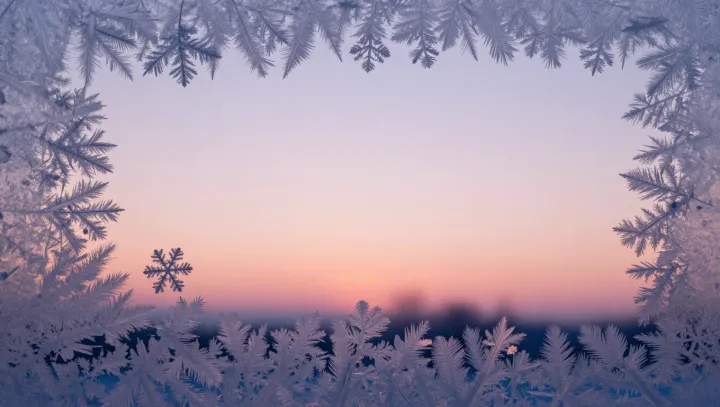
Frost on glass is not decoration. It is a physics experiment running itself in silence, driven by temperature gradients only a fraction of a degree wide and specks of dust smaller than a grain of powder. From those tiny asymmetries, ice branches shoot outward, splitting and resplitting until the pane looks uncannily like an aerial map of a jagged shore or a forked lightning strike.
The striking claim from physicists is simple. Coastlines, trees, lightning, and frost all answer to the same growth rule known as diffusion-limited aggregation, in which particles wandering by random thermal motion stick on contact and bias growth at the outer tips. Water molecules in cold air diffuse toward the glass, and where dust slightly alters surface energy or local humidity, a first microscopic crystal locks in, turning that point into a more efficient collector of vapor. New molecules preferentially attach at exposed edges, where the concentration gradient is steepest, so branches sharpen while flat regions stagnate.
This is not artistic flourish; it is a feedback loop written into thermodynamics and phase transition theory. Each new protrusion amplifies the local heat flow and vapor flux, so it claims even more incoming molecules, just as a river channel steals water from nearby trickles. Scale up the math and the similarity index that describes a rocky coast appears again in the statistics of frost dendrites. The pane of glass becomes a quiet archive of how simple rules carve complexity out of random motion.