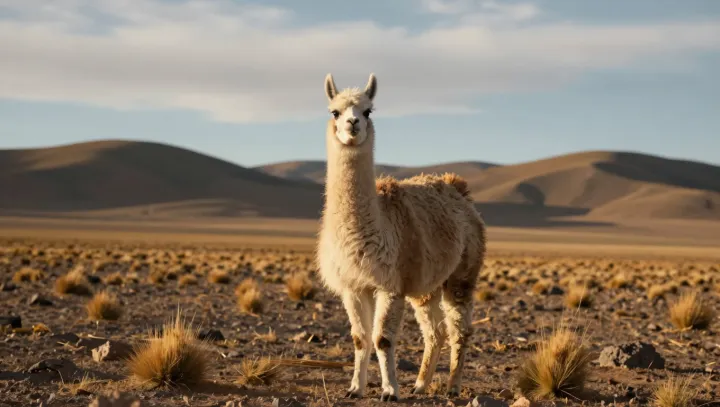
That motionless llama is not relaxed at all. It is running an extreme austerity program on its own biology, trading movement for survival in thin, dry air where every breath and every drop of water must justify its cost. Stillness becomes a physiological budget meeting, not a mood.
At altitude, oxygen is scarce, so cutting locomotor activity slashes whole‑body metabolic rate and with it mitochondrial oxygen consumption. Less muscle work means reduced cardiac output and slower respiratory drive, which lowers evaporative loss from lungs and mouth. A standing, immobile posture also limits isometric muscle contractions to a narrow set of antigravity muscles, keeping adenosine triphosphate turnover low while skeletal muscle remains ready for sudden flight if a predator appears.
The calm pose also manages heat. In open desert, any unnecessary stride adds internal heat that must be dumped by panting or peripheral vasodilation. By staying still, the llama relies more on passive thermoregulation: radiative exchange with the air, controlled blood flow through its dense fur, and a relatively small exposed surface area facing direct sun. With less internal heat to shed, it can keep sweat rates minimal, preserving body water and maintaining plasma volume for oxygen transport.
Even behavior joins this energy calculus. Long, quiet scans of the horizon reduce the need for repeated start‑stop bursts of movement that spike catecholamines and glucose use. The animal stretches vigilance over time instead of paying for it in expensive sprints. What looks like a meditative pause is in fact a continuous, low‑power operating mode tuned to a place where mistakes are paid for in water, not in minutes.