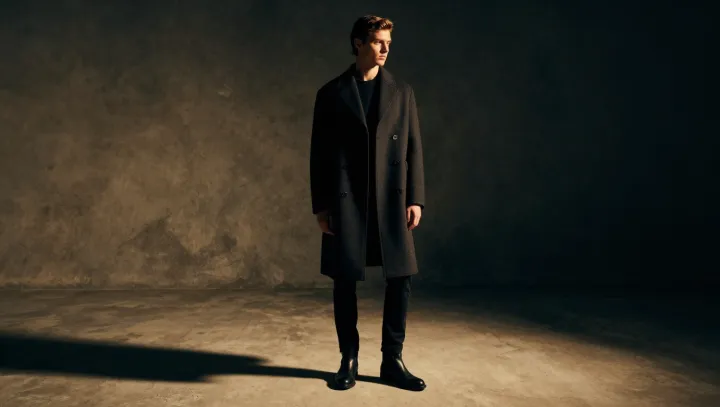
A long dark coat does the talking before any word is spoken. Thick fabric, clean lines and a single unbroken column of color compress a man’s outline into something that reads as stable, shielded, self-contained. Against that visual frame, even an ordinary posture starts to look like intent rather than accident.
The bolder claim is that the coat and a steady sideward gaze can fake authority more reliably than any short speech. Social cognition research on “enclothed cognition” and “thin-slice judgment” shows that observers form impressions within milliseconds, using clothing and gaze as heuristics for status and self-efficacy. A long dark coat echoes uniforms and formal outerwear associated with command roles, so the brain shortcuts: protected body, higher rank. When the gaze shifts sideways and holds, without fidgeting, it mimics dominance displays seen in ethology and in studies of gaze aversion and territorial control. Strangers read that as choice, not shyness.
The uncomfortable truth is that the man inside can stay anxious, junior, or uncertain while the surface signals run ahead of him. Perception systems reward coherence of silhouette and calm eye behavior, not inner biography. The coat and the gaze simply lock those fast, biased judgments in place long enough for the rest of the story to catch up—or not.