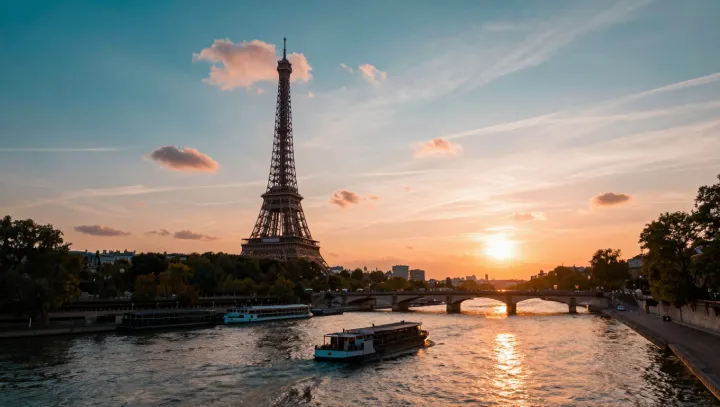
At dusk, the Seine becomes a mirror with an argument. No new physics. The air has lengthened sunlight's route, allowing Rayleigh scattering to send more short-wavelength blue light out of the direct beam. What reaches the river can lean red or amber, while the governing event remains elastic scattering, not a chemical alteration of light.
Perception, not chemistry. A river does not merely reflect a sky: its rippled surface mixes specular reflection with darker banks, bridges, and depth, producing local contrasts that make warm highlights appear more intimate than they would against a blank horizon. Color constancy then enters quietly. The visual cortex discounts illumination while registering adjacent hues; red beside slate-blue or shadowed water gains emotional force, even though each photon obeys the same electromagnetic rules before and after the eye receives it.
That distinction matters because poetry is often mistaken for a property of objects. It is not. Rayleigh scattering changes the angular distribution of visible wavelengths as sunlight crosses air; it does not install longing in water. Yet optics supplies the cue, and memory supplies the charge, drawing on learned associations of dusk, letters, departures, and return. The result feels personal. A red Paris sky above the Seine is neither scientific error nor mere decoration: it is a physical signal completed by a mind, like ink becoming a letter only when someone reads it.