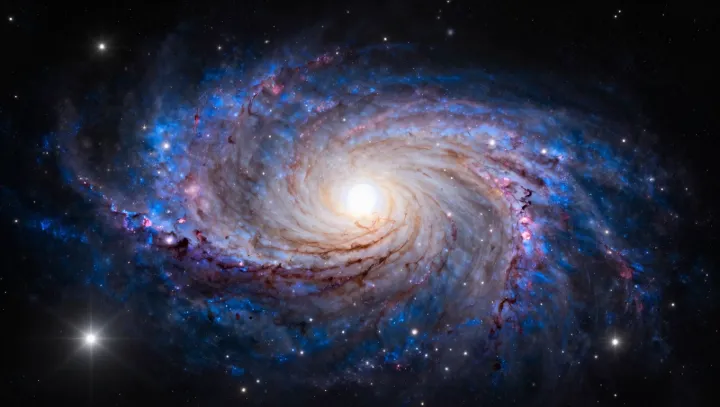
The blue arms look calm; they are not. Along their curved lanes, gas clouds compress, cool, and collapse under gravity, producing stellar nurseries whose newborn stars emit enough short-wavelength light to tint whole sections of the disk. Still, the color is a brief condition.
The nucleus is the harder story. Its concentrated glow can come from an enormous population of aged stars packed near the galactic center, where stellar density raises the background light beyond that of the arms. Yet in some systems, accretion onto a supermassive black hole adds a harsher source: an active galactic nucleus, fed by an accretion disk whose heated material radiates before crossing the event horizon. Two engines, one glare.
That contrast makes a spiral galaxy less a portrait than an argument. Its arms advertise youth, but the bulge keeps the longer ledger: star formation follows cold molecular gas into gravitationally unstable pockets, whereas stellar evolution leaves older populations concentrated near the center. The image lies still. Behind it, radiation, orbital motion, and black-hole feeding continue to rearrange the evidence, placing fresh blue light against a dense store of ancient mass. The question is not which region is more alive, but how many different clocks can occupy one visible form.