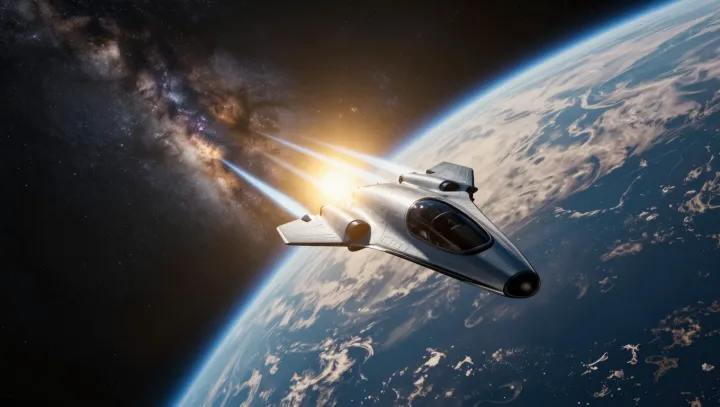
A spacecraft at orbital speed performs physics' sharpest fake-out: it falls toward a planet while moving sideways so fast that the ground curves away beneath it. It is not fleeing. Gravity continuously turns the velocity vector, producing a closed path instead of a straight departure.
That freedom is disciplined captivity. Inertia would send the craft along a tangent, but gravitational acceleration pulls it inward; when the inward fall matches the planet's curvature, the craft remains in free fall and misses the surface again and again. Orbital mechanics resembles a game engine's steering loop. Under Newtonian gravitation, the force supplies centripetal acceleration, not a brake, so the craft keeps its sideways momentum. At one altitude, a faster craft enters a larger ellipse, while one exact speed creates a circular orbit.
Escape is a different bargain. An orbit is bound because its specific orbital energy is negative; a craft must add enough energy to reach escape velocity, where it will not return, even though gravity still affects its course. Thrust changes the deal. A prograde burn can lift the far side of an orbit, called apoapsis, and repeated burns can eventually unbind it. This is no cosmic treadmill. With autonomous guidance and precise burns, spacecraft can turn a planet's pull from confinement into a launch mechanism, then chain gravitational encounters across a solar system.