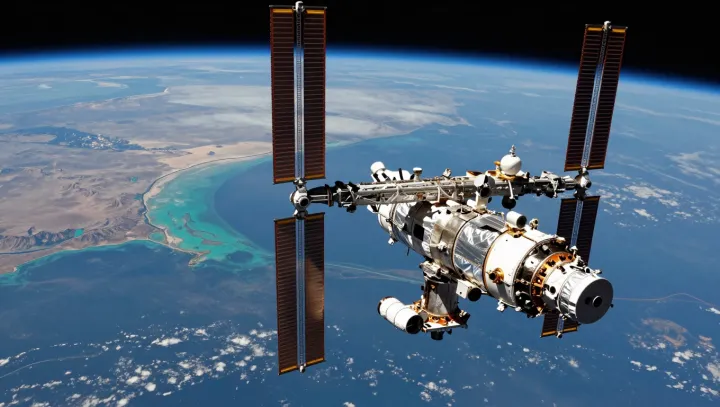
Weightlessness is badly named. At the International Space Station's altitude of roughly 400 kilometers, Earth's gravitational acceleration remains about 89 percent of its surface value, hardly an absence of gravity. The missing ingredient is support. Astronauts float because the station, its occupants and its loose contents are all falling together, rather than standing against something that arrests their fall.
Orbit is controlled falling. Traveling sideways at about 7.7 kilometers per second, the station drops toward Earth while the planet's surface curves away beneath its path, so it keeps missing the ground. Gravity does the steering. It supplies the centripetal acceleration that bends the station's trajectory into an orbit; without that pull, the spacecraft would continue along a straight path instead. The floor stops pushing. On the ground, a floor exerts an upward normal force on your feet, and that support creates the sensation of weight; in shared free fall, no comparable support is needed.
Floating proves no escape. An astronaut and a released object follow nearly the same orbital motion, which explains why the object seems suspended beside its owner instead of dropping toward the cabin floor. The effect remains imperfect. Atmospheric drag, equipment vibrations and small differences in gravitational pull across the station introduce residual accelerations, making microgravity a more accurate label than zero gravity. A tethered world drifts. Behind a floating droplet and beyond the window, Earth maintains its hold without giving the cabin anything resembling a floor.