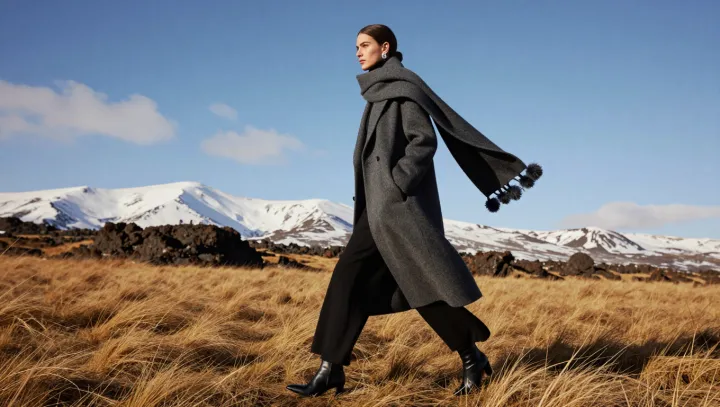
Polish comes from restraint. An oversized charcoal coat needs neither a bright accessory nor another generous layer beneath it, because its broad shoulders and falling hem already supply the outfit's strongest gesture. Volume needs a counterweight. Against a narrow base, the coat's drape becomes legible: fabric hangs around the body rather than competing with an equally expansive shape underneath.
The base deserves discipline. A fine knit worn with straight trousers or slim jeans gives the eye a continuous line, while a bulky sweater can push the coat outward and blur its intended shape. Fit need not squeeze. In tailoring, ease describes the allowance beyond body measurements; keeping that allowance modest underneath leaves the outer layer room to move without making every layer look oversized. Footwear should stay composed. A neat ankle boot or low-profile loafer keeps the lower half visually contained, particularly when the trouser hem meets the shoe without bunching.
Texture beats another color. A brushed wool scarf, a fine rib, or a soft cashmere weave can introduce surface variation within charcoal, gray, or black, where differences in finish remain visible without a sharp color contrast. The knot matters too. One loose turn with the ends falling close to the lapels adds softness, whereas repeated wrapping builds a collar that can crowd the face and obscure the coat's opening. Leave some air visible. Beneath the generous shoulders, a narrow strip of knit and a quiet fall of scarf let the wearer emerge from the cloth.