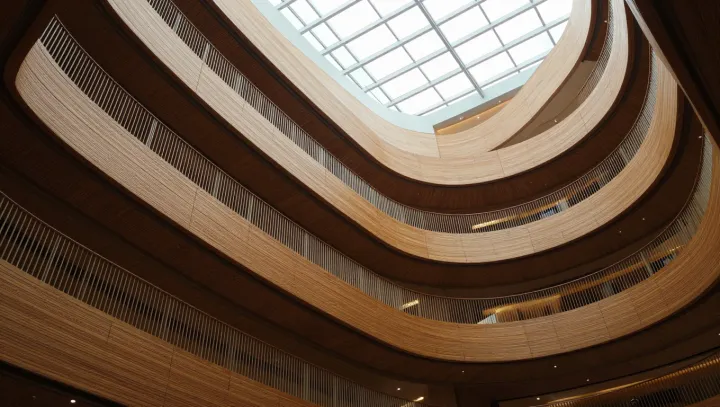
Stillness does the work. An evenly spaced wooden roof can cast stripes that travel across a floor because Earth's rotation changes the direction from which sunlight reaches the gaps. The timber stays put. What appears to be movement in the roof is actually a changing projection, drawn by sunlight onto the surfaces below.
Spacing alone explains little. Although identical gaps establish a repeating pattern, solar altitude, the sun's angle above the horizon, and solar azimuth, its compass direction, determine where each strip of direct sunlight lands. Geometry supplies the motion. For a horizontal receiving surface beneath the roof, lower sunlight generally produces greater sideways displacement, while changes in compass direction can shift the bands across different parts of the space. Orientation matters as much. Slat width, depth, alignment and height above the floor determine whether sunlight passes freely, narrows into ribbons or is blocked at particular angles.
Perfect stripes are conditional. Because the sun appears as a disk rather than a single point, shadow edges develop a penumbra, a partially shaded margin that generally broadens as the receiving surface moves farther from the slats. Clouds soften the effect. Diffuse skylight arrives from many directions, filling shaded areas and reducing contrast, whereas direct sunshine makes the repeating bands more distinct. Uniform gaps need not produce uniform brightness, especially where walls intercept the rays or reflected light reaches the floor. Nothing overhead has stirred. Beneath the timber, a bright edge quietly crosses the room.