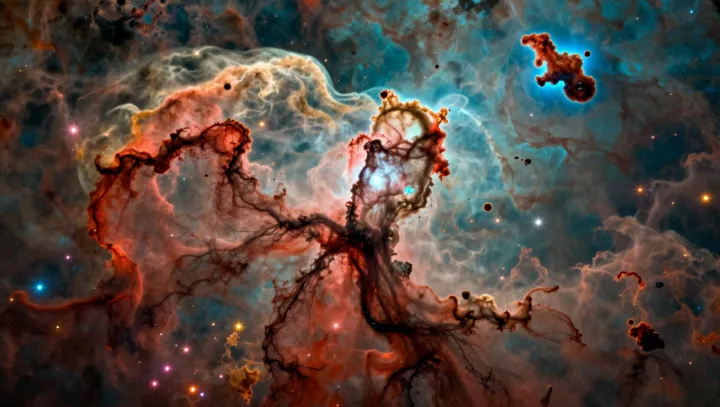
Absence can command the picture. A massive star outside the frame can shape towering pillars of gas and dust because its ultraviolet radiation strips away exposed material while denser pockets resist erosion. Height disguises their vulnerability. What looks like an assembly of solid columns is instead the uneven remainder of a cloud being dismantled, with each surviving ridge marking a difference in density.
These towers are temporary survivors. Through photoionization, energetic photons remove electrons from atoms, heating exposed gas until it can expand away from the cloud in a process called photoevaporation. Density buys them time. Where compact clumps absorb incoming radiation, they shield material behind them, allowing elongated structures to persist while their less protected surroundings disappear. Dust shares the shelter. Although the visible pillars are often named for their dust, gas supplies much of their substance, and the sculpting depends on how radiation interacts with that gas rather than on dust alone.
Survival carries a double edge. Radiation can compress gas near an illuminated boundary, potentially helping some dense regions collapse under gravity, yet the same exposure can remove material needed for star formation. Compression guarantees no birth. Whether a particular pillar nurtures stars depends on its density, internal motions, and irradiation, so its shape alone cannot establish that the nearby star triggered new stellar growth. The frame withholds its author. Beyond the edge sits the source of the pressure, while inside it the remaining columns hold their outline against the light that is slowly taking them apart.