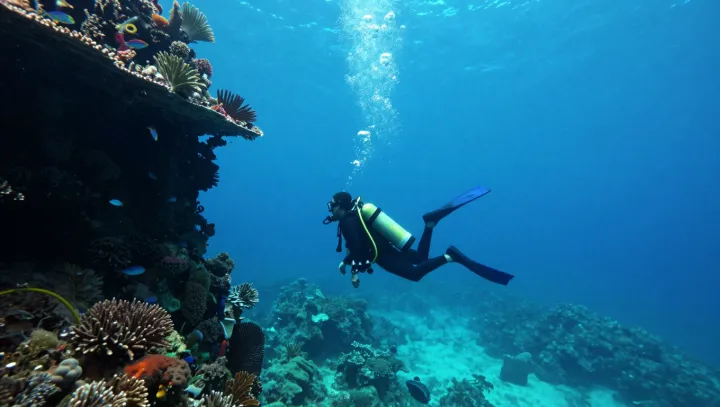
Shallow water offers false reassurance. During a scuba ascent, even the last few feet can injure lungs if expanding gas cannot escape, because the pressure outside the chest falls while trapped gas pushes outward. Depth alone misleads. The danger comes from a pressure difference across delicate lung tissue, not from some minimum depth that guarantees safety.
The arithmetic is unforgiving. Boyle's law states that a fixed quantity of gas expands as its absolute pressure falls, provided temperature remains constant; a scuba regulator supplies breathing gas at approximately the surrounding water pressure. The surface amplifies this. From roughly 33 feet of seawater to the surface, absolute pressure halves, allowing trapped gas to double in volume if unconstrained. Smaller ascents matter too. Gas taken in about three feet down would expand by roughly nine percent on reaching the surface, which can strain already inflated lungs when an airway is closed. That is not a rupture threshold.
The worst injury can travel. Pulmonary barotrauma can tear alveoli, the lungs' tiny air sacs, allowing gas into surrounding tissues or the chest cavity; gas entering pulmonary veins can reach arteries and obstruct blood flow to the brain. Seconds can change everything. Sudden confusion, weakness, breathing difficulty, or collapse after ascent warrants emergency care, even when the dive seemed shallow. Prevention is deliberately undramatic. Breathe continuously during normal scuba ascent, follow trained ascent procedures, and never hold your breath; slow movement alone cannot protect lungs when gas remains trapped. Above the diver, daylight promises an arrival that physics does not guarantee.