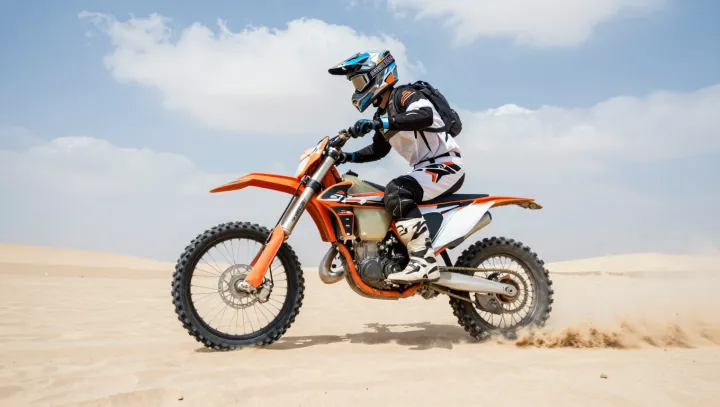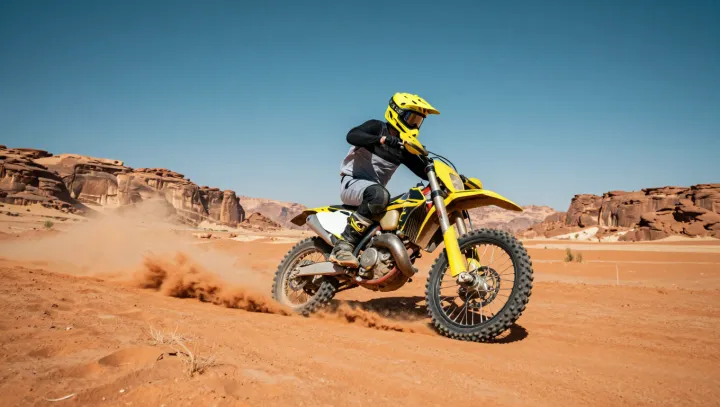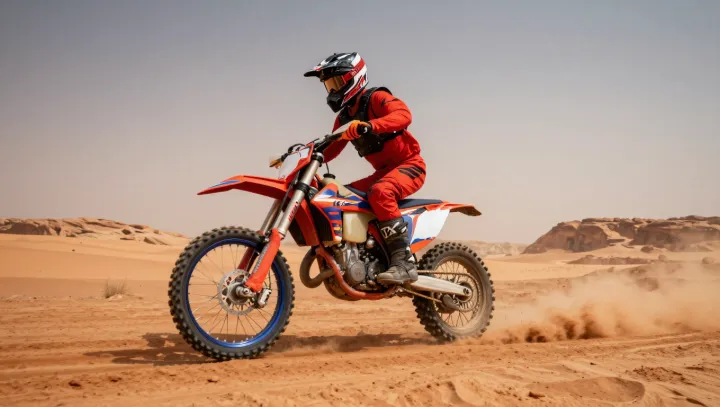
Less rubber can win. On loose ground, a dirt bike tire gains traction not simply by touching the surface, but by driving its widely spaced tread blocks into material that would otherwise slide beneath it. Empty space earns its place. Those gaps let individual blocks penetrate soil and give displaced dirt somewhere to go, rather than trapping it beneath a continuous rubber belt.
Grip requires some disturbance. Because the load is concentrated over the rubber actually touching the ground, contact pressure can help the blocks sink through loose surface material, although tire inflation and soil conditions also affect penetration. Depth alone guarantees nothing. Once embedded, the blocks push against soil, whose shear strength determines how much force it can resist before breaking or sliding. The ground pushes back. That reaction supplies driving or braking force, while block edges and orientation also influence cornering traction; if the soil gives way too easily, the wheel still spins.
Clean gaps matter too. As the tire rotates, tread flexing and centrifugal effects can help release packed material through the spaces between blocks, exposing their edges for another bite instead of leaving a mud-coated surface. There is a price. On hard ground, where blocks cannot penetrate, tall, widely spaced knobs may flex, wear quickly, and feel less stable than tread designed for that surface. More spacing is no cure. The useful gap is the one matched to the soil: behind the turning wheel, an interrupted print records a firmer purchase.