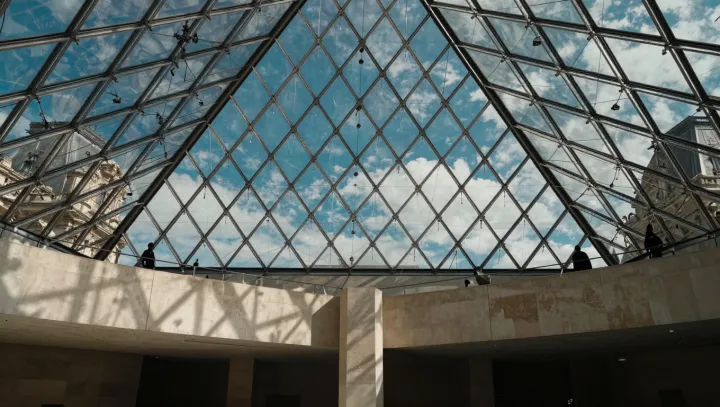
The Louvre began with exclusion. Built to defend Paris rather than display paintings, its fortress enclosed a massive keep behind a curtain wall and moat, features whose surviving foundations still confront visitors beneath the galleries. The world's most-visited art museum rests, quite literally, on an architecture designed to keep people out.
Royal comfort defeated military necessity. As Paris expanded beyond its defenses, the stronghold lost its defensive purpose, and successive rulers converted it into a residence before replacing much of it with a palace. Francis I promoted that rebuilding while collecting Italian art, including the Mona Lisa, which entered the royal collection. Collecting served the crown. After Louis XIV established his court at Versailles, the Louvre increasingly accommodated artists, academies and royal collections, although its conversion into a public museum still required a revolution against the monarchy that had assembled those treasures.
Public access changed the bargain. Revolutionary authorities opened the former palace as a museum, making royal possessions available to citizens, while confiscations, purchases, donations and archaeological excavations expanded its holdings. Empire complicated the inheritance. Napoleon's armies brought seized artworks to Paris, many of which were returned after his defeat, leaving questions of provenance that still shadow museum collections. Later building campaigns enlarged the exhibition space, and the glass pyramid reorganized entry through a courtyard once associated with royal power. The reversal remains incomplete. Beneath rooms crowded with visitors seeking the Mona Lisa and the Venus de Milo, the surviving moat holds its silence: a boundary built for exclusion, now itself an exhibit.