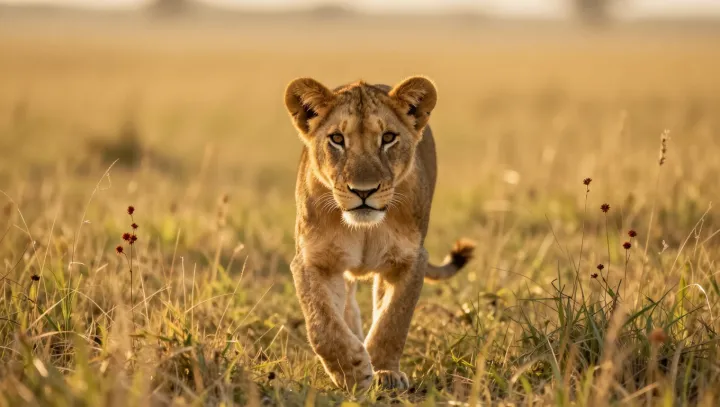
A lion's first advantage is concealment, not command: cubs arrive wearing spots that help them disappear among grass, scrub and broken shade while their mothers hunt. Majesty can wait. Unlike the largely uniform coats associated with adults, these juvenile markings suit an animal whose immediate business is avoiding notice rather than confronting rivals.
The spots deserve more credit than their nursery charm suggests, because camouflage depends on what a watching animal can distinguish against the surrounding vegetation. Pattern defeats easy recognition. Dark markings can help interrupt the cub's outline, an effect described as disruptive coloration, while patches of shade make a spotted coat harder to separate from its surroundings. Pigment supplies the contrast. Melanin, the pigment responsible for dark coloration in mammalian hair, produces markings whose usefulness depends partly on light, cover and the observer's visual system. Concealment is no guarantee. Cubs remain vulnerable to predators and other threats, and their mothers hide them in sheltered places before introducing them to the pride.
The fading is less absolute than the familiar adult silhouette implies, since some grown lions retain faint spots, especially on their legs and underparts. Traces can survive maturity. As cubs develop, their coats generally become more uniformly tawny, although the visibility and persistence of juvenile markings vary among individuals. Adulthood changes the picture. Larger bodies, greater mobility and participation in pride life reduce dependence on the secluded hiding places used by small cubs, without making concealment irrelevant to hunting lions. Beneath the adult's apparent plainness, childhood sometimes remains legible.