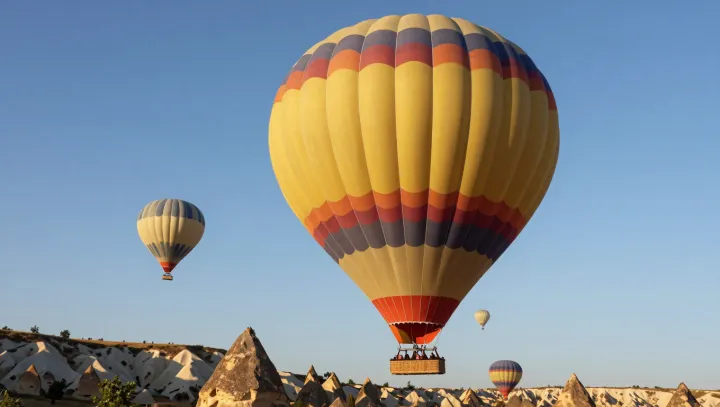
Romance comes without steering. A hot-air balloon has no steering wheel, and its pilot influences the route by climbing or descending into air moving in a different direction. Control is a negotiation. Rather than pointing the basket toward a destination, balloon flight depends on finding winds that make the desired journey possible.
Altitude is the real lever. Because wind velocity can change with height, a phenomenon called vertical wind shear, moving between layers can alter both the balloon's course and its ground speed. The burner buys height. Heating the air inside the envelope reduces its density relative to the surrounding atmosphere, allowing buoyancy to lift the balloon when the upward force exceeds its weight. Descent requires less lift. As the enclosed air cools, or hot air escapes through a vent, the balloon can settle into another layer, although its response is not instantaneous.
Choice still has limits. Wind layers do not obligingly offer every compass direction, so no amount of burner work guarantees arrival at a chosen picnic spot or a return to the launch field. Preparation beats wishful thinking. Pilots assess weather, study winds at different heights and consider landing options, while ground crews commonly follow to retrieve the balloon after touchdown. Calm can be deceptive. Because the basket travels with the surrounding air, passengers may feel little breeze even while crossing the ground, suspended in a vehicle whose freedom depends on accepting what it cannot command.