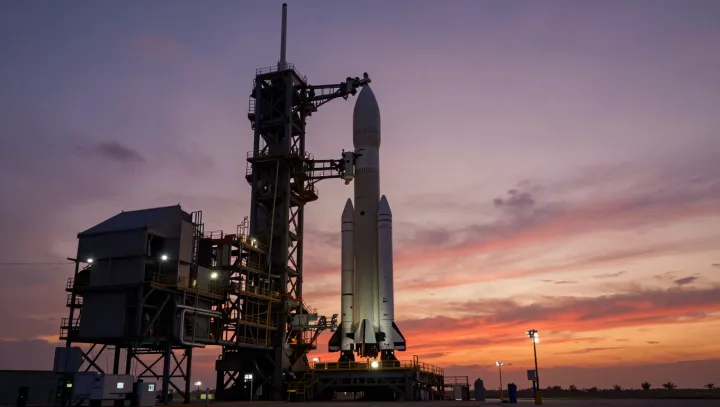
Height alone buys no orbit. Although Crew-6's Falcon 9 must lift its astronauts above the atmosphere's thickest layers, the more demanding assignment is to build enough sideways velocity that their spacecraft keeps missing Earth as gravity pulls it downward. Orbit is controlled falling. Without that sideways motion, a capsule sent upward would eventually return rather than circle the planet.
Gravity is not defeated. At the International Space Station's altitude, roughly 400 kilometers above Earth, gravitational acceleration remains about 90 percent of its strength at the surface, supplying the centripetal acceleration that bends a spacecraft's path. Speed changes the outcome. For a nearly circular orbit at that height, orbital velocity is about 7.7 kilometers per second, fast enough that Earth's surface curves away beneath the falling vehicle. Weightlessness follows shared free fall. Astronauts float because they and their capsule accelerate together under gravity, not because they have escaped its reach.
The climb serves the turn. After rising clear of the launch pad, Falcon 9 progressively tilts through its ascent, directing more thrust along Earth's surface while gaining the altitude needed to limit atmospheric drag. Altitude still earns its place. Too low, and collisions with air molecules drain orbital energy; too little sideways speed at a given height, and the flight path can intersect denser air or Earth itself. Engines need not run continuously. Once the spacecraft has the required position and velocity, gravity sustains its curved flight, with occasional thrust correcting its course or replacing energy lost to drag. Earth remains below, endlessly approached.