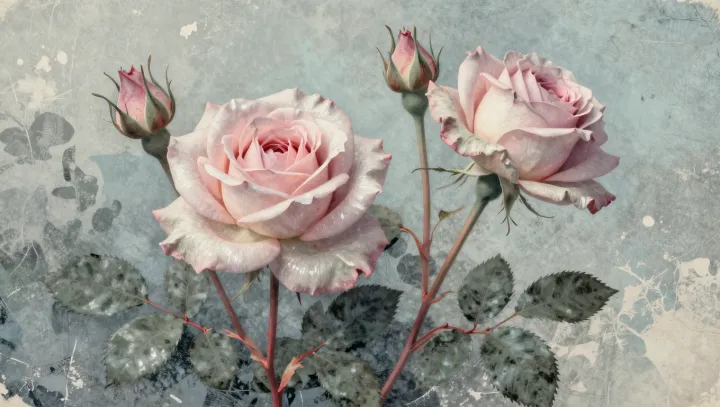
Mist edits the light. Around a pink peony, suspended water droplets redirect illumination, making the bloom appear softer even though its petals retain their shape and texture. The apparent transformation is optical. What looks like a flower slipping into a dream is, more precisely, a reduction in the differences between bright surfaces, shaded folds and the space behind them.
Contrast does the work. Because mist droplets are generally larger than visible light wavelengths, their interaction with light is commonly described using Mie scattering, which redirects light without requiring any change in the flower itself. Shadows lose their bite. When scattered light enters the viewing path, it can add veiling luminance, lifting darker areas and diminishing the separation that makes edges look crisp. Pink may seem paler. That impression depends on illumination, droplet concentration and viewing distance, rather than on mist somehow removing pigment from the petals or physically smoothing their surfaces.
Softness has its limits. A nearby bloom can preserve considerable detail while a more distant background fades, because light crossing a longer stretch of mist encounters more droplets and suffers greater contrast loss. Distance changes the bargain. For a photographer, this means the flower need not be blurred to look delicate; its fine structures can remain visible while surrounding tones draw closer together. The petals stay themselves. Between their folds, shadows still occupy the same small recesses, but the light no longer insists on showing every boundary.