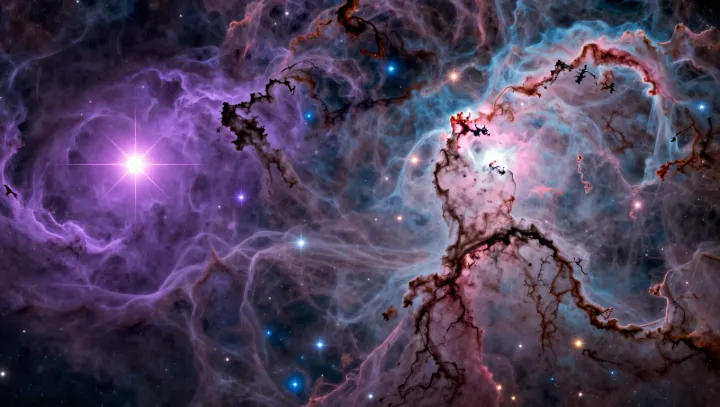
Starlight comes at a price. In NGC 346, massive stars illuminate the gas around them while driving winds into the same material from which other stars and planets could emerge. Their brilliance is no blessing. What looks like a nursery at peace is a cloud under pressure, with its brightest residents helping to rearrange, and sometimes remove, its remaining supplies.
The violence has distinctions. Within this star-forming region in the Small Magellanic Cloud, ultraviolet radiation strips electrons from atoms through photoionization, while stellar winds deliver momentum as streams of particles collide with surrounding gas. Light is not wind. These separate agents work together to excavate cavities, heat exposed material and alter the conditions under which gravity can draw gas into denser concentrations. Destruction is not guaranteed. Where expanding gas compresses neighboring material, it can encourage collapse, although demonstrating that a particular star formed because of that pressure requires more than an evocative image.
The smallest structures matter. Around young stars, disks of gas and dust supply the ingredients for planets, but radiation from massive neighbors can heat exposed disk gas enough for it to escape. Survival becomes a local question. Distance from the brightest stars, intervening material and the density of a cloud or disk all influence how much fuel remains available rather than being dispersed. Beauty offers no protection. Across NGC 346, the luminous gas marks an unsettled bargain: the stars that make the nursery visible also help decide what it can still become.