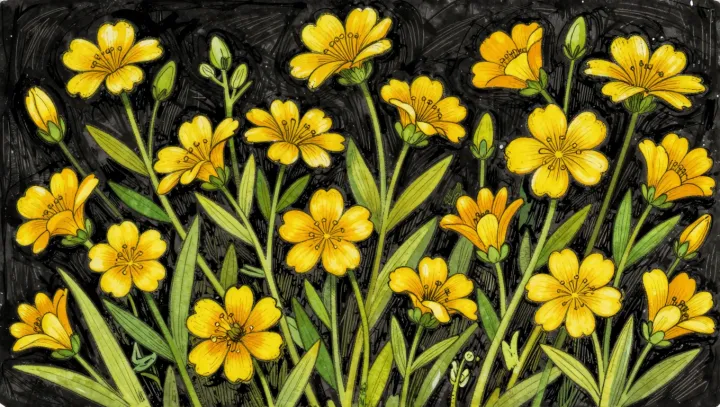
Plainness is a human verdict. A yellow flower that appears uniformly colored can carry contrasting ultraviolet markings, because its petals reflect wavelengths that human eyes generally cannot detect but bee eyes can. The difference is biological. What looks unmarked to one observer may present another with a distinct pattern around the flower's center.
The petals aren't changing costumes. In some flowers, flavonoids concentrated near the petal bases absorb ultraviolet radiation, while outer regions reflect more of it, producing a contrast that remains hidden within an apparently consistent yellow surface. Chemistry supplies the contrast. Bees possess photoreceptors sensitive to ultraviolet, blue and green wavelengths, whereas human color vision normally depends on receptors sensitive to longer wavelength ranges. Yellow tells only part. Because ultraviolet reflectance can vary independently of visible coloration, matching yellows need not mean matching signals to a bee.
The pattern isn't merely decoration. Often called nectar guides, these markings can help bees orient toward floral rewards, although their effects depend on the flower, the insect and other cues such as scent and shape. A photograph needs caution. An ultraviolet image can record the reflectance differences, but its displayed colors are human-readable substitutions rather than a faithful portrait of what a bee experiences. Nor are patterns universal. Some yellow flowers lack such markings, and even patterned flowers are not guaranteed visits simply because their ultraviolet contrast is detectable. The petal keeps its secret. Beneath the same sunlight, two eyes find different flowers.