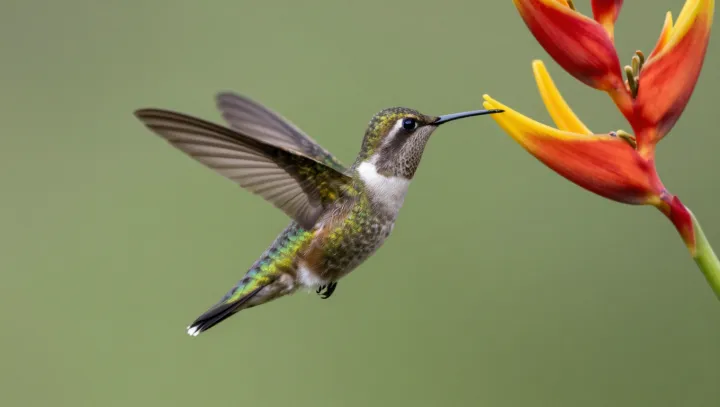
The hummingbird tongue is no straw. A hermit hummingbird reaches into a flower with its long, curved bill, but the tongue does the collecting: its tip changes shape in nectar, trapping liquid that the bird carries back to its mouth. The distinction matters, because suction is not what drives this feeding trick.
The tongue is better understood as a tiny trap. Its tip divides into two grooved branches, whose fringes open as they enter nectar and close around the liquid as the tongue withdraws. Surface tension helps retain the nectar, while elastic recoil helps the tongue regain its shape. Researchers studying hummingbird feeding have challenged the older explanation that capillary action alone pulls nectar up the tongue. The bird repeatedly extends and retracts it, gathering small loads in quick succession rather than drawing a continuous drink through a tube.
The bill is a guide, not a pump. Its curve can help a hermit reach nectar deep inside a flower, while hovering lets the bird feed without landing; hermits may also perch to feed. This access comes at a price: hovering demands energy, making nectar a valuable fuel. Flowers gain something too. As a bird reaches inside, pollen can attach to its body and travel to another bloom. For a moment, bird and flower meet at the narrow edge between feeding and reproduction.