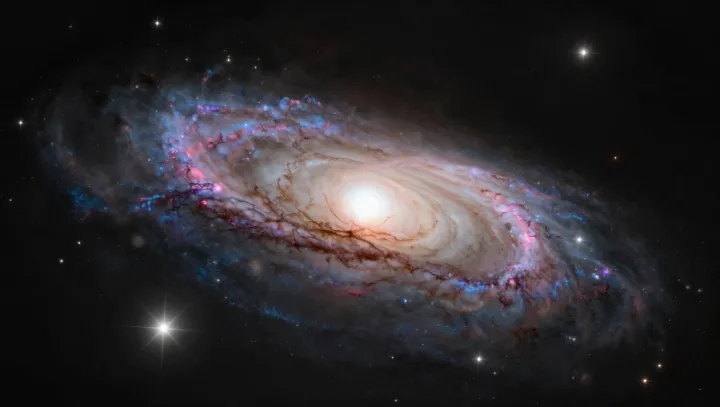
A galactic collision is less a crash than a rearrangement on an immense scale. Stars almost never strike one another, even when their parent galaxies pass through each other and emerge distorted. The reason is space: stars are tiny compared with the distances separating them, leaving abundant room for them to pass.
Gravity, however, refuses to leave the encounter unchanged. Each galaxy pulls more strongly on the nearer parts of its companion than on the farther parts; these tidal forces can stretch disks, fling stars and gas into long tidal tails, and alter the paths of entire populations of stars. The effect is collective, not a matter of stars trading blows. Individual orbits respond to the changing gravitational field, and repeated encounters can eventually bind the galaxies into a single remnant. Not every encounter ends that way, but even a passing one can leave visible scars.
The gas tells a more turbulent story. Unlike stars, gas clouds are extended and can collide, compressing material and helping dense regions collapse under their own gravity. A burst of star formation may follow, although the outcome depends on how much gas is available and how the galaxies meet. Some gas can also be driven toward the center of a galaxy, where it may feed a central black hole. These processes take vastly longer than any earthly collision, and their brightest traces can outlast the closest approach. Across the dark, the stars slip past; the galaxies do not.