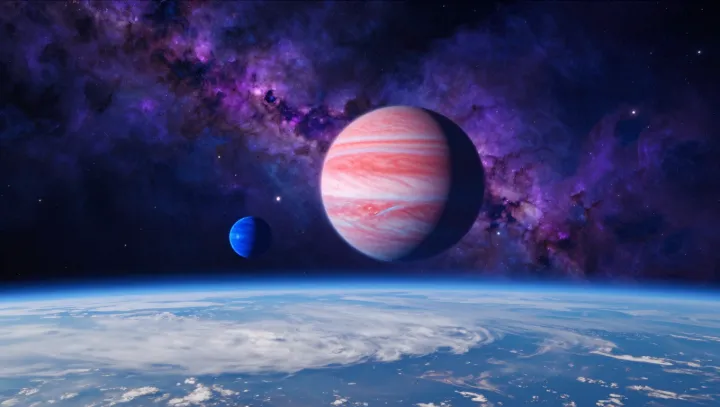
The universe is not short of color; the human eye is short of light. An illustration may place brilliant planets and glowing clouds above Earth's curved horizon, but an actual nebula often appears pale or gray through a telescope. The difference lies less in the gas than in the machinery of sight.
Night vision makes a poor color critic. The retina relies mainly on rods in dim conditions; these cells are sensitive to faint light but do not distinguish colors. Cones, which supply color vision, need more light to work well. Nebulae spread their emission across large areas of sky, leaving each small patch too faint to stimulate the cones strongly. The colors are there. Hydrogen can emit red light, while ionized oxygen produces blue-green light; whether either registers as color depends on brightness and viewing conditions.
A camera has an advantage that the eye cannot simply borrow. Its sensor can collect light over a long exposure, building a signal from photons that arrive too sparsely for an immediate visual impression. Filters and image processing can isolate emissions or assign visible colors to wavelengths outside human sight, so an astronomical image is not always a literal record of what an observer would see. Bright nebulae can show some color through a telescope, but magnification alone cannot make their extended surfaces brighter to the eye. Against that quiet gray, the illustrated sky offers a different kind of truth: color imagined where vision falls silent.