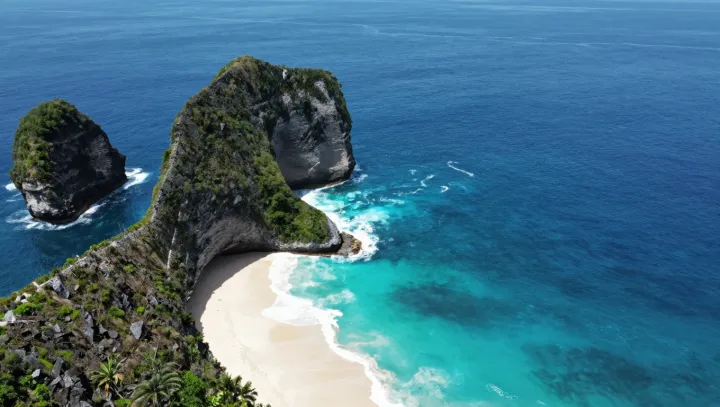
Kelingking's famous headland is less a monument to a dinosaur than a record of a vanished seabed. Its steep limestone cliffs, rising above turquoise water on Indonesia's Nusa Penida, began as marine sediment before forces beneath the island brought rock into the reach of waves and rain. The resemblance came later.
The first architect was the sea itself. In warm, shallow water, fragments of shells and other carbonate material accumulated on the seabed; burial and lithification then compacted and cemented those sediments into limestone. Tectonic uplift raised the rock as forces associated with the collision and convergence of crustal plates reshaped the region. Not every layer rose evenly, and fractures created weaknesses that water could exploit. What had formed underwater was exposed to air, rainfall and surf.
The cliffs owe their shape as much to subtraction as to uplift. Wave erosion wears away exposed rock at the coast, while rainwater can dissolve limestone through a chemical process known as carbonation. Fractures widen, loosened blocks fall, and weaker sections retreat at different rates. Over long stretches of time, those processes can isolate a projecting ridge while cutting back the rock beside it. The outline is not fixed. It is a passing likeness held between the raised seabed and the water still working at its edge.