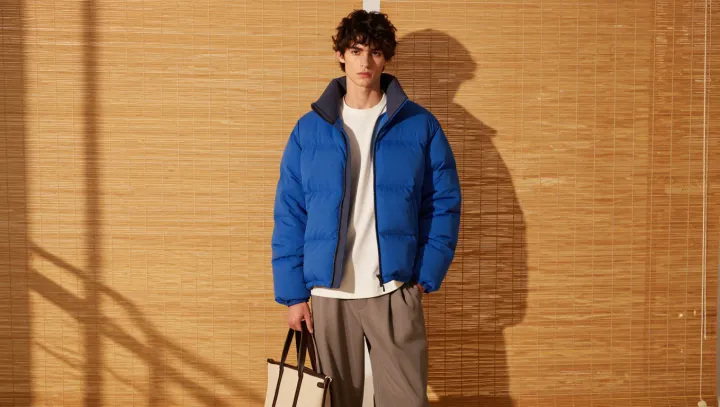
Two voluminous pieces can make a sharper silhouette than one. The trick is placement. A light blue puffer that ends near the waist gives loose trousers room to fall from a visible midpoint, so the outfit reads as two deliberate shapes rather than one uninterrupted block of fabric.
The white shirt does more than fill the gap. It draws a line. Worn with its hem visible below the jacket, it separates the padded upper body from the trousers; tucked in, it marks the waist more directly. Either approach works, though a shirt that hangs too far below the jacket can blur the break. In garment construction, the hemline and rise determine where that division appears: a higher trouser rise brings it up, while a lower rise lets the jacket and shirt occupy more of the frame. Light blue against white keeps the layers distinct without a harsh contrast.
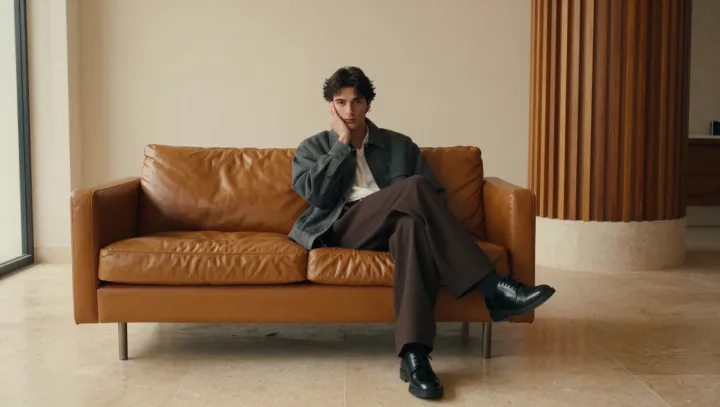
Width needs direction, not restraint. Let the trousers fall. A straight or gently wide leg carries the jacket's fullness downward, while a fabric with some drape avoids adding another rigid shape. Shoes with enough visual weight to meet the hem can ground the look; a very delicate shoe may disappear beneath a broad cuff. Sleeve length matters as well: a cuff near the wrist keeps the cropped jacket from swallowing the hands. Balance here is not a question of making either piece smaller, but of letting each occupy its own space. Between the two, a strip of white holds the composition open.