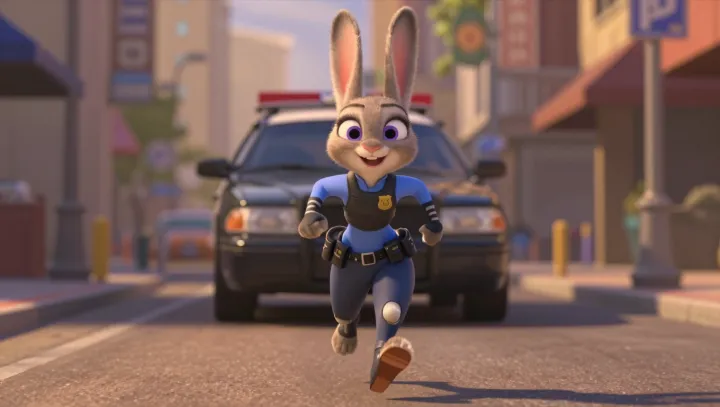
Judy Hopps breaks one stereotype only to breathe life into another. As the first rabbit police officer in Disney's Zootopia, she proves that a small animal can do a job reserved by custom for larger ones, yet her investigation into missing mammals exposes a prejudice she has failed to recognize in herself.
Her badge is no shield against bias. Assigned to parking duty despite her ambitions, Judy bargains for a chance to investigate a missing otter and recruits Nick Wilde, a fox whose own encounters with discrimination have taught him to distrust others. Their partnership unsettles the assumption that rabbits are helpless and foxes are inherently dishonest. But when Judy publicly suggests that predators may be reverting to a biological tendency toward violence, she gives fear the authority of a police officer. Nick hears the accusation clearly: even his friend sees his species as a threat.
The film's sharpest point is that exclusion and prejudice can coexist in the same person. Judy's remark turns individual cases into a claim about an entire group, an example of essentialism reinforced by implicit bias. Predators face suspicion across the city, and Nick walks away. Judy later apologizes, and together they discover that the animals were deliberately drugged with night howlers as part of a plot by Assistant Mayor Bellwether. The conspiracy explains the attacks; it does not erase the damage Judy's words caused. Her badge catches the light, but it cannot tell her whom to trust.