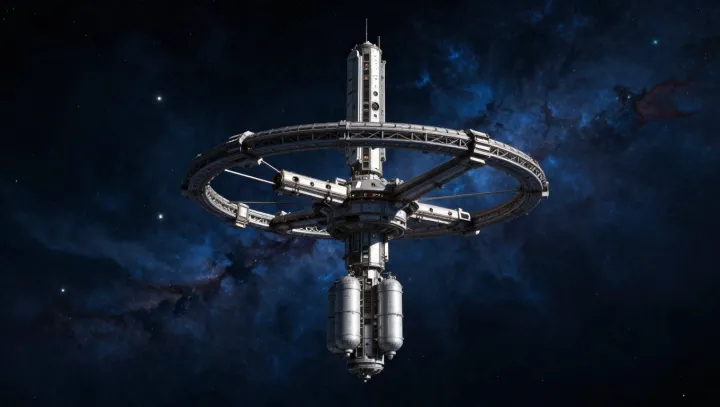
Metal arcs into the dark, not as a broken ring but as a deliberate radius. A crewed station begins to spin, its modules sliding outward over time, tension growing along every truss. The design bakes in a quiet paradox: a habitat that survives by constantly pushing itself closer to the point where it could fail.
The physics is simple and unforgiving. To create artificial gravity, the structure uses centripetal acceleration, turning rotation into a stand‑in for weight that keeps bone density and muscle mass from collapsing toward microgravity baselines. Near‑Earth gravity levels demand significant radius and angular velocity, which translates directly into mechanical stress, thermal fatigue and vibration. Engineers treat the station almost like an endocrine system managing homeostasis: sensors track strain, regulators adjust spin rate, and maintenance cycles respond to what is, in effect, controlled entropy increase written into the metal.
Living closer to Earth conditions reduces long‑term damage to the cardiovascular system and helps stabilize circadian rhythm, metabolic rate and even crew psychology, but it forces a new trade‑off in orbital architecture. The more natural the gravity feels underfoot, the more aggressively bearings, cables and pressure hulls must negotiate tension. A future in which “up” and “down” exist in orbit may depend on how precisely designers can choreograph this slow, intentional act of coming apart without ever crossing the line into fracture.