On some stellar corpses, a teaspoon of surface material would weigh as much as a car on Earth. These objects are white dwarfs and neutron stars, the compact leftovers of once-normal stars that have burned through their fuel and shed their outer layers.
Their extreme gravity comes from packing roughly solar mass into a radius thousands to millions of times smaller than the Sun. In white dwarfs, electrons are squeezed into a state known as electron degeneracy pressure, a quantum effect described by the Pauli exclusion principle. In neutron stars, matter is pushed even further, with protons and electrons merging into neutrons and neutron degeneracy pressure taking over. The result is enormous surface gravity: the gravitational acceleration can reach billions of times that on Earth, so even a teaspoon of crust would register as car-scale weight in an Earth laboratory.
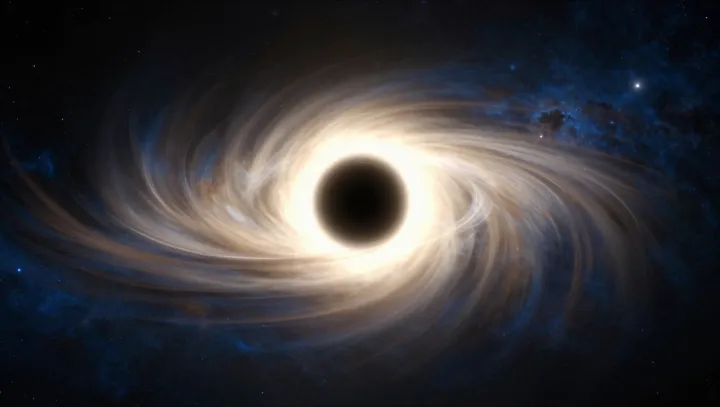
Yet these objects stop short of becoming black holes because internal pressure still balances gravity. General relativity sets a critical compactness: only if mass is confined within its Schwarzschild radius does an event horizon form. White dwarfs remain safely above this threshold, and neutron stars sit just on the edge; beyond a certain mass limit, degeneracy pressure fails and collapse continues into a black hole. The teaspoon-on-a-car comparison marks that narrow regime where quantum pressure and gravity are still in delicate equilibrium.