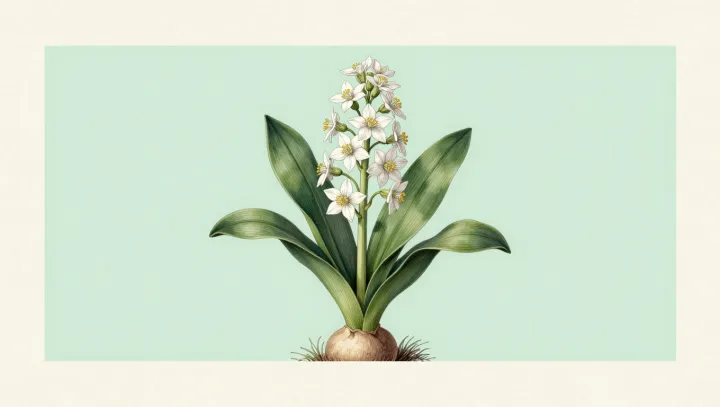
Leaves rising from deep shade announce today’s daily flower: the Hosta, often called the plantain lily. Classified in the family Asparagaceae and the genus Hosta, this herbaceous perennial traces its original distribution to mainland China before spreading through global horticultural trade.
Within plant systematics, the Hosta occupies a precise niche: a rhizomatous perennial adapted to low-light environments, where its broad foliage maximizes photosynthetic surface area while maintaining a relatively low baseline metabolic rate. That morphology, combined with its capacity for clonal propagation via rhizome division, has generated substantial marginal effects in ornamental horticulture, turning a once-local understory species into a standard feature of temperate shade gardens across continents.
Landscape designers now use Hosta as structural foliage rather than as a fleeting bloom, leveraging its dense leaf canopy to suppress weeds, stabilize soil moisture, and create a cooler microclimate at ground level. In mixed plantings, its layered leaves offer a visual counterpoint to fine-textured ferns and grasses, while its inflorescences provide vertical accents that signal seasonal change. From its origin in Chinese woodland habitats to curated borders in urban courtyards, the plant has shifted from regional flora to global design element, quietly redefining how shade is treated as usable garden space.