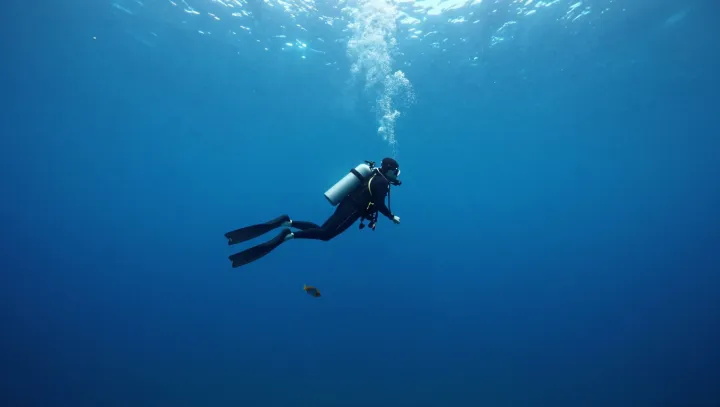
Dark water turns a familiar reef into an almost abstract space. That is why experienced night divers insist on visiting the same site in daylight first: they are not sightseeing, they are building a map. Rock lines, sand channels and entry points are logged as reference nodes in the brain before the light drops.
Underwater at night, vision collapses into a flashlight cone and key depth cues vanish. Without ambient light, stereopsis and motion parallax give unreliable distance estimates, while color constancy breaks down as red wavelengths disappear quickly in water. A diver may misjudge a wall as open water or read a gentle slope as a sudden drop, even when buoyancy control is technically sound.
Daytime scouting creates a cognitive chart that later substitutes for missing sensory input. The diver links compass bearings to fixed structures, rehearses exit routes against the shoreline silhouette, and notes where thermocline shifts or stronger currents begin. At night, the torch then acts less as a searchlight and more as a pointer to an existing mental model, helping the brain maintain spatial orientation when instruments and eyes can no longer fully agree.