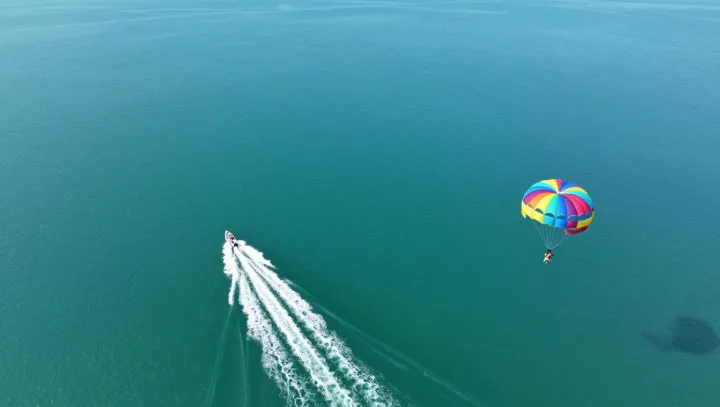
Canvas and rope rise from the water, and the line goes tight. The body hangs in a harness, but the sensation is neither simple ascent nor free fall. Parasailing feels like flying and diving in the same breath because the towline, the wing-shaped canopy, and the moving boat keep trading control of your motion.
The same basic equations that govern an airplane wing are at work here. As the boat pulls you forward, air flows faster over the curved canopy, reducing static pressure and creating aerodynamic lift. Gravity pulls you down, while drag resists your motion through the air. Your path becomes a shifting balance of lift, weight, thrust from the boat, and drag, not a single clean climb.
When the boat speeds up, lift increases and you arc upward like a slow, wide takeoff. When it eases or turns, lift drops relative to your weight and you sink, tracing a gentle dive instead of a plunge. The towline fixes your horizontal speed, but vertical motion keeps adjusting as angle of attack and relative wind change. To your inner ear, that constant rebalancing feels like two opposite experiences fused into one.
What seems like a carefree ride is actually continuous real-time negotiation between Bernoulli principle and Newtonian mechanics, written in air pressure and velocity rather than ink. The body swings at the intersection of those invisible forces, suspended between sky and sea.