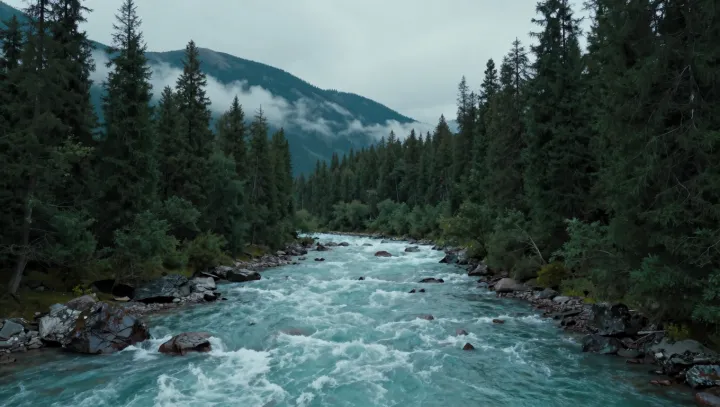
Clear water racing over stone can, at certain points along a mountain stream, carry fewer live microbes than the water coming from a kitchen faucet. The explanation lies not in treatment plants or disinfectants but in physics, geology and microbial competition playing out in real time.
Fast, shallow flow creates intense turbulence and high shear stress, which damage fragile cells and disrupt biofilms. Constant mixing maximizes contact between water, air and sunlight, boosting dissolved oxygen and exposing microbes to ultraviolet radiation. This natural combination of aeration and UV disinfection alters microbial load before the water travels far downstream.
Beneath the visible channel, water repeatedly seeps into gravel and sand, then re-emerges. This hyporheic exchange acts as a continuous, low-pressure filtration system, where adsorption and sedimentation remove particles and many pathogens. Microbial ecology in these sediments is shaped by competition and predation, with protozoa and bacteriophages reducing bacterial populations and increasing ecological entropy in the community.
Tap water, by contrast, moves through long, enclosed distribution networks. Even after chlorination and coagulation, residual nutrients, pipe roughness and biofilm formation can allow regrowth of some microorganisms. The hydraulic residence time in pipes gives surviving microbes a stable surface and predictable environment, a marginal effect that sometimes offsets gains achieved at the treatment plant.