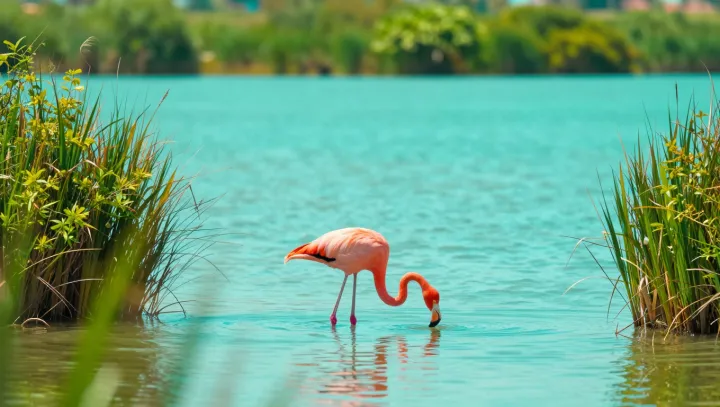
One-legged flamingos are not wobbling; they are in their most stable configuration. Biomechanics research shows that a relaxed bird can balance more steadily on a single leg than on two, even when it appears to be asleep.
The key is anatomy and passive dynamics. When a flamingo tucks one leg and lets the other align under its center of mass, the joints in the hip, knee and ankle move into a locked configuration. Ligaments and tendons create a self-stabilizing linkage, so the bird’s skeleton bears most of the load. This reduces active muscle contraction and lowers its basal metabolic rate for posture. The body becomes a kind of inverted pendulum resting in a mechanical sweet spot, where small sways are corrected by gravity and joint geometry rather than continuous neural control.
That same configuration helps flamingos sleep. With muscles largely offloaded, the nervous system can scale back constant postural reflexes and reallocate energy to thermoregulation and tissue repair. Standing on one leg also cuts the surface area exposed to water or air, limiting convective heat loss through the limbs. Instead of fighting entropy with constant micro-adjustments, the bird exploits structural biomechanics: the more completely it commits to the one-legged pose, the more the system behaves like a stable, low-energy structure rather than a balancing act.