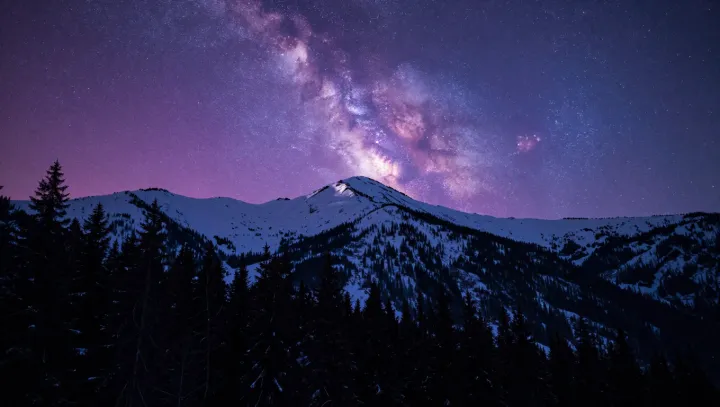
A strip of stars across an almost black sky looks like nothing more than pale texture to the naked eye, yet cameras routinely render it as a detailed, colorful Milky Way. The trick is not magic but physics: a tripod holds the scene still while the sensor gathers every available photon during a long exposure that stops just short of visible star trails.
A fast wide‑angle lens admits far more light per unit time than the human pupil, and the camera stretches that short interval into an effective integration window. During those seconds, the image sensor converts incoming photons into electrons, building up a stronger signal while thermal noise and read noise remain comparatively stable. This improves the signal‑to‑noise ratio and lets faint structures in interstellar dust and gas emerge without being drowned in electronic grain.
Color comes from preserving the spectral distribution of that weak light. Shooting in raw format avoids early compression and allows later adjustment of white balance and gamma without discarding subtle chromatic information. By balancing aperture, exposure time and sensor sensitivity, and by working far from light pollution that would raise background luminance, photographers use basic optics and photometry to reveal a galactic landscape that human vision, optimized for motion and metabolic efficiency rather than integration time, simply does not resolve.