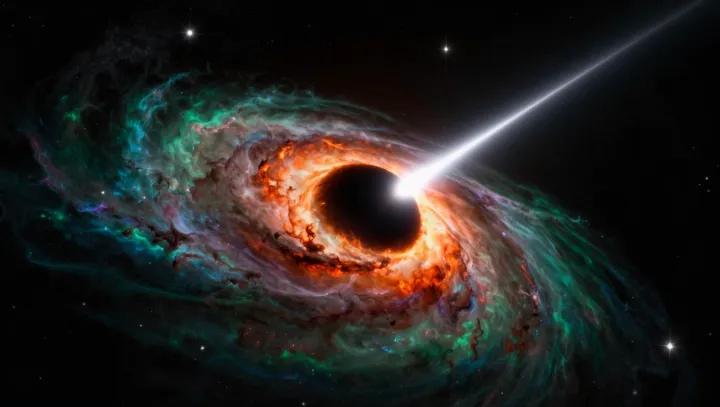
Around a black hole, darkness is framed by a violent ring of light. Matter spirals inward, crushed by extreme gravity, and the region just outside the event horizon flares with radiation. The object that will erase every trace of what falls in is preceded by a luminous boundary where energy is spent with ruthless efficiency.
The key is that a black hole does not simply swallow gas like a vacuum bag; it forces infalling material into an accretion disk. As gas orbits, friction and magnetic turbulence convert gravitational potential energy into heat, driving temperatures to millions of degrees. At those energies, atoms are stripped into plasma and emit intense X rays and gamma rays. Per unit mass, this conversion can outshine nuclear fusion, pushing radiative efficiency close to the theoretical limits set by entropy increase and relativity.
Magnetic fields twist through the disk and funnel part of the inflowing material into narrow relativistic jets that blast away from the poles at speeds near that of light. These jets, powered by the spin of the black hole and the disk, act as cosmic searchlights, visible across vast distances. The black hole itself remains invisible; no light escapes from within the event horizon. What astronomers detect is the last, furious release of energy as matter crosses the final gravitational margin between bright universe and permanent night.