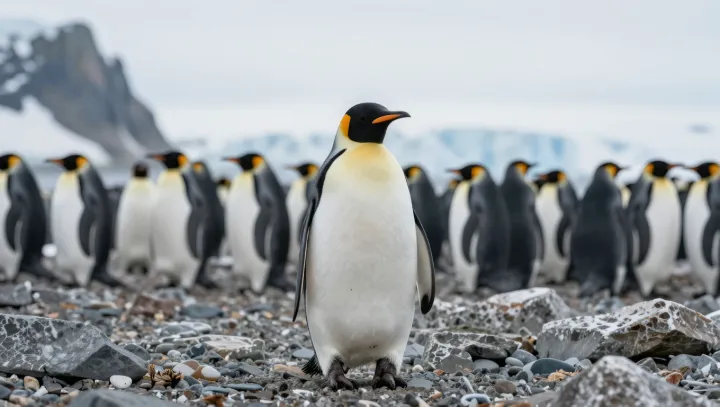
A bird that “flies” underwater faster than many relatives cross the sky is locked to the ground, unable to lift off. That paradox is the outcome of a long evolutionary trade, where every gain in water turns into a loss in air.
Penguin wings evolved into stiff flippers with reduced joint mobility and a low aspect ratio, optimized for generating thrust in a dense fluid. Water’s higher density and viscosity reward compact hydrofoils, allowing high lift and low drag at swimming speeds that would stall most birds in air. Dense bones act as built in ballast, countering buoyancy and stabilizing the body, while streamlined body contours cut form drag and turbulence. The same traits that maximize hydrodynamic efficiency make traditional flapping flight aerodynamically and energetically prohibitive.
Inside the body, a high basal metabolic rate and powerful oxidative muscle fibers supply the sustained power needed for rapid underwater “flight” and deep diving. Fat distribution and air sac volume tune buoyancy rather than supporting aerial lift. Once this system crossed a threshold, reversing it would demand a complete redesign of skeletal architecture, feather microstructure and respiratory mechanics. Evolution followed the local optimum: a specialist swimmer with wings that behave like underwater propellers, superb in one medium and effectively grounded in the other.