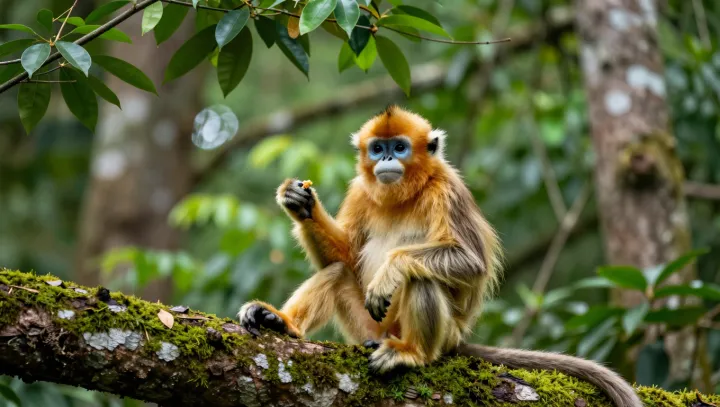
Forest canopy becomes a living map where fruiting trees, nut caches, and insect hotspots are encoded in a monkey’s brain with startling precision. Long before a human would need a calendar or a note-taking app, a wild primate is already running a mental navigation system tuned by survival pressure.
The key lies in spatial memory circuits, especially within the hippocampus and related neural networks, which evolved under a harsh constraint: miss the right tree and you go hungry. Over generations, natural selection favored individuals with stronger pattern separation, route planning, and recall of food locations. In humans, that same hardware is repurposed and crowded by language, social cognition, and abstract reasoning, so the signal about yesterday’s meal competes with a flood of other inputs.
Monkeys also benefit from a tight loop between procedural memory and foraging routines. Repeated travel along stable routes consolidates synaptic plasticity, turning the landscape into something like a well-indexed database rather than a messy inbox. Working memory is deployed on a narrow task set: find, reach, eat. Human attention, by contrast, fragments across notifications, tasks, and social obligations, increasing cognitive load and entropy in daily recall.
Ecologists describe this as an information-foraging trade-off: monkeys invest neural resources in high-resolution spatial data because it maximizes energy return. Human brains, optimized for flexible culture, storytelling, and technology, accept a cost in mundane episodic detail. The monkey remembers where the figs are; the human remembers a password, a plot twist, and a deadline, but not the sandwich.