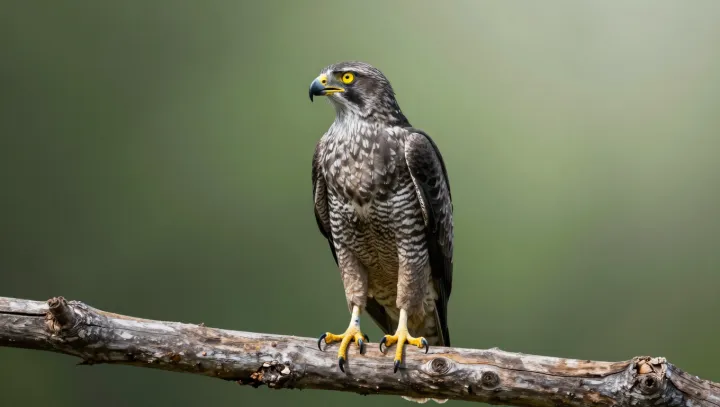
Stillness on a perch is not idleness. For a falcon, it is a low‑energy surveillance state that protects basic metabolic rate while keeping the entire sensory system on standby for a single, rapid strike.
Behind the apparent calm, the visual cortex and fovea run continuous high‑resolution tracking on distant movement. Specialized photoreceptors, deep eye sockets and a nictitating membrane support image stability at extreme angular speeds. When a target’s trajectory fits a narrow kinematic window, neural circuits in the midbrain trigger a pre‑programmed dive pattern rather than a slow, conscious decision.
Fast‑twitch muscle fibers in the breast and wing power instant acceleration, while a stiff keel and interlocking vertebrae stabilize the skeleton for high‑g maneuvers. Aerodynamic shaping of wings and tail, combined with contour feathers that manage boundary‑layer flow, reduces drag and maintains controllable lift even as velocity climbs. Pressure sensors along the skin and in the beak feed real‑time data to balance system and spinal reflex arcs, allowing micro‑corrections without visible hesitation.
The long periods of apparent inactivity therefore function as an efficiency strategy: conserve energy, gather information, then convert stored potential into a short, optimized burst of speed and precision.