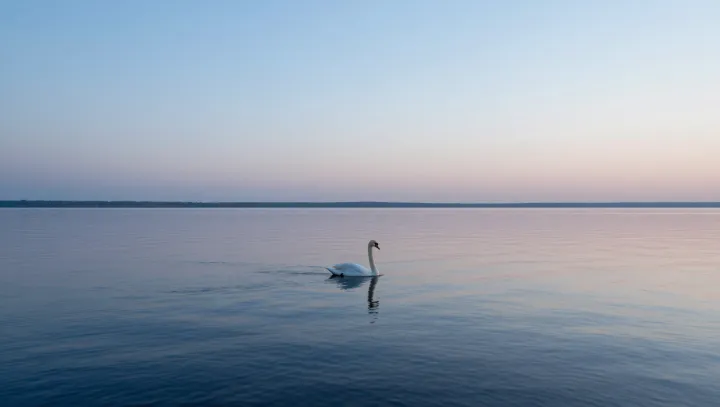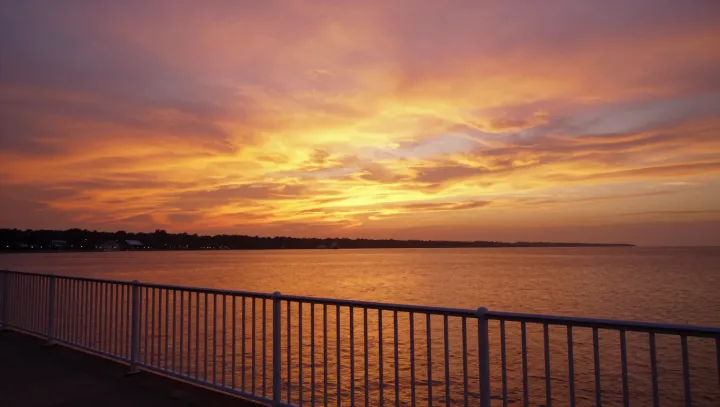
A tiny change in position along a riverbank can rewrite the entire sunset. Shift a few meters and the sun’s angle of incidence, the water’s reflection path, and the background alignment all reconfigure the scene your eyes and camera register.
At one spot, the sun sits high above the river’s specular reflection, forcing your camera sensor to cope with a brutal dynamic range: a blinding sky and a dark foreground that collapses into a flat orange band. Move sideways and the same sun now grazes the water at a shallower angle, so Fresnel reflection sends a bright path of light straight toward you. That glowing strip lifts midtone luminance, compresses the contrast between sky and land, and gives the sensor a scene it can record without clipping everything to pure white or muddy black.
The shift also reshuffles silhouettes. Trees, bridges, or distant buildings slide into layered overlap, creating parallax depth instead of a single hard horizon line. With the sun partially occluded, its apparent brightness drops, color saturation survives sensor white balance, and gradients in the sky become resolvable detail rather than a blown-out blob. The sunset has not changed; only your vantage point has altered the geometry of light, and with it, the story your camera can tell.