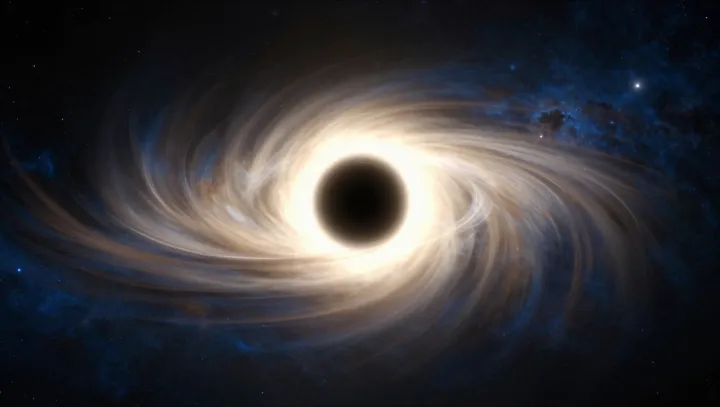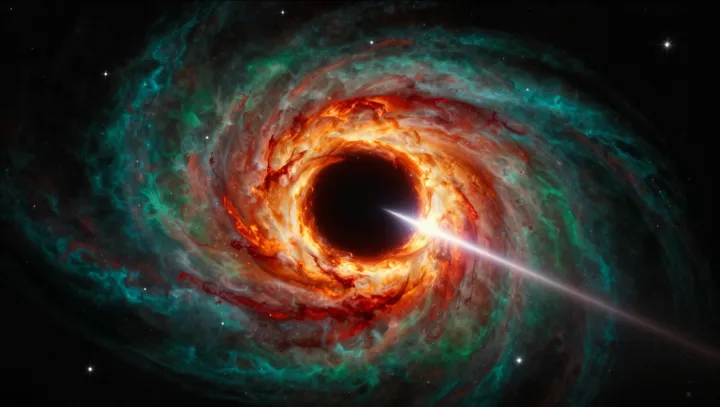
Around a feeding black hole, space does not look empty. Gas spirals inward, forming a dense accretion disk that heats up as friction and gravitational energy build. Instead of falling straight in, particles crash into one another, converting gravitational potential energy into heat and high-energy radiation, from X-rays to gamma rays, that telescopes can pick up across vast distances.
The brightest spectacle comes from jets. As the disk orbits, it drags and twists magnetic fields into tight coils. Plasma near the black hole’s event horizon becomes locked to these fields and is flung outward at relativistic speeds, close to the speed of light. This process, described by magnetohydrodynamics, can tap the black hole’s spin energy through mechanisms such as the Blandford–Znajek effect, turning a gravity well into a cosmic particle accelerator.
Seen from afar, a black hole with an active disk and jets is less a silent sink than a high-gain energy transformer. The same extreme gravity that pulls matter in also sets the conditions for efficient energy extraction, radiation, and collimated outflows. The so-called vacuum cleaner becomes one of the universe’s loudest beacons, broadcasting its presence across the electromagnetic spectrum.