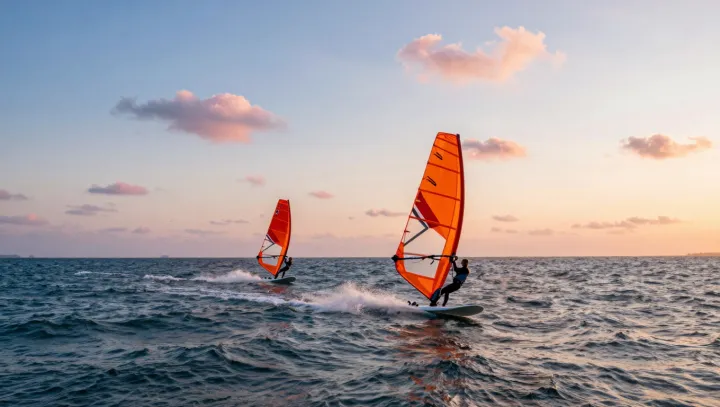
A single breaking wave behaves less like a frozen ramp and more like a moving field of probability, yet two surfers can ride it side by side without colliding. Beneath each board, pressure gradients, laminar flow and turbulent eddies reorganize every instant, but the riders still find separate lines across the same unstable surface.
The key is that the ocean does not need to repeat itself for the brain to solve it. Continuous sensory input from the soles, ankles and inner ear feeds a rapid control loop known in biomechanics as closed‑loop feedback. Tiny shifts in buoyancy, drag and angular momentum are converted into micro‑adjustments of stance and rail angle, allowing each surfer to carve a distinct trajectory through the shared velocity field of the wave.
Around that physics sits an invisible protocol stack: surf etiquette. Priority rules assign the critical pocket to a single rider, pushing the second surfer to a different section with lower collision probability. Visual scanning, anticipation and game‑theory style risk assessment operate almost automatically, so that even as the Navier–Stokes turbulence under both boards remains irreproducible, the pair co‑create a temporary traffic system on water.